Payroll Outsourcing in 2026: Benefits, Costs & How It Works

Key Takeaways
- Payroll outsourcing means delegating payroll tasks: salary calculations, tax filings, statutory submissions, and employee payments, to a third-party provider
- Businesses of all sizes benefit: it removes administrative noise, reduces compliance risk, and frees HR teams to focus on what actually moves the needle
- Common pricing models include per-employee-per-month, flat monthly fees, and custom enterprise pricing
- Choosing the right provider matters, so look for local compliance expertise, transparent pricing, and a team that acts as an extension of yours
Managing payroll in-house sounds simple. But a missed filing deadline can trigger a fine, and a salary error can cost you a key employee.
Payroll outsourcing fixes that. In this guide, we cover what it is, how it works, what it costs, and how to choose the right provider.

What Is Payroll Outsourcing?
Payroll outsourcing is when a company delegates its payroll operations to a third-party provider.
That provider manages processes like salary calculations, tax filings, and employee payments, so your team doesn't have to.
Instead of running payroll in-house with all the compliance complexity and admin overhead, you hand it to specialists who do this every day.
Companies outsource payroll for three main reasons: complexity, compliance risk, and efficiency.
As regulations change and teams grow, managing payroll internally becomes harder. And more expensive.
Further reading: Evolution of payroll outsourcing | brioHR's integrated payroll outsourcing service | HR outsourcing in ASEAN | Payroll outsourcing for disruptions
"We work with mid-size growing companies who are better not to focus their money and energy on compliance and administrative matters, and rather ensure that their team operates in the best conditions to contribute to the company’s success"
Key Benefits of Payroll Outsourcing
Outsourcing payroll removes the administrative noise, so HR can focus on what actually drives impact. Here's what businesses gain.
1. Lower Costs
Building an in-house payroll team means salaries, benefits, training, and software licenses.
Outsourcing replaces all of that with a predictable fee.
brioHR co-founder Benjamin Croc puts it directly: "Mid-size growing companies are better off not focusing their money and energy on compliance and administrative matters, and rather ensuring that their team operates in the best conditions to contribute to the company's success."
One brioHR client, a 70-employee company with APAC presence headquartered in Singapore, reduced operational costs by 60% after switching to a combined payroll and Human Resources Management System (HRMS) solution.
Pro tip: Factor in hidden in-house costs: compliance penalties, payroll error corrections, and the hours your HR team loses to admin instead of strategic work.
2. Time Savings
Every payroll cycle involves data collection, calculations, approvals, disbursements, and compliance checks.
That's a significant drain every single month.
Outsourcing hands that workload to a provider, freeing your HR team to focus on performance, engagement, and the work that actually matters.
For startups, this is especially valuable. One brioHR client, a 20-employee company in Malaysia with no HR team and the founder handling payroll alone, was able to redirect that time entirely to growth and product development after outsourcing.
3. Compliance Support
Tax laws change. Statutory rates get updated. New employment regulations come into effect.
Staying compliant requires constant monitoring across every market you operate in.
Payroll outsourcing providers employ specialists who track those changes for you.
In ASEAN markets like Malaysia, Singapore, and Indonesia, the requirements are complex and regularly updated: Employees Provident Fund (EPF), Social Security Organisation (SOCSO), Potongan Cukai Bulanan (PCB), and Central Provident Fund (CPF).
Side note: Most businesses remain legally liable for compliance even when outsourcing. Always choose a provider with a documented track record in your specific region.
4. Improved Accuracy
Manual payroll calculations are error-prone. Overpaying an employee is expensive and hard to recover.
Underpaying one damages morale and risks legal action.
Reputable providers use automated systems backed by expert review, which means fewer payroll errors, fewer headaches, and more consistent salary runs.
5. Scalability
As headcount grows (or shrinks), payroll complexity grows with it.
New hires, terminations, benefits changes, and multi-cycle runs all add layers of work.
Outsourced payroll scales with your business without requiring additional payroll headcount. Whether you're 10 people or 500, the provider adjusts.
One example: a 700-employee company operating across 80 locations in Malaysia used brioHR's combined HRMS and payroll outsourcing to centralise data management and reduce friction across high employee turnover. It was a challenge that internal systems simply couldn't keep up with.
6. Access to Expertise
Payroll legislation varies by country, industry, and employment type.
Most in-house teams can't maintain deep expertise across all of these.
Outsourcing gives you access to specialists who focus on payroll compliance every day, without adding to your headcount.
For companies expanding regionally, this is critical. As Benjamin Croc explains: "You need to master multi-country compliance, and because it is difficult, and the team size does not justify having the strongest experts in-house, companies make mistakes that might prove very expensive down the line."
7. Better Employee Experience
When employees have payslip questions, they shouldn't have to chase the HR team.
A good payroll provider includes self-service portals where employees can view payslips, submit claims, and update personal details.
This reduces HR queries and cuts payroll software costs, while keeping employees informed and satisfied.
"A well executed and error free payroll strategy can improve retention, boost morale, and reflect the values of your organization."
What Does Payroll Outsourcing Include?
A full-service payroll outsourcing engagement typically covers:
- Salary and wage calculations: including overtime, deductions, and prorated salary for new joiners and leavers
- Statutory contributions and tax submissions: EPF, SOCSO, PCB in Malaysia; CPF in Singapore; Badan Penyelenggara Jaminan Sosial (BPJS) in Indonesia
- Salary disbursement: generating bank files and ensuring on-time payments each payroll cycle
- Payslip generation and distribution: digital payslips accessible via employee self-service
- Year-end and annual tax filings: employer reports, EA forms, and jurisdiction-specific documents
- Payroll reporting: workforce cost breakdowns by department, location, and period
- HR system integration: syncing payroll data with time attendance, leave, and HRMS tools
- Employee query support: handling payroll-related inquiries directly, reducing your HR team's workload
How Payroll Outsourcing Works (Step-by-Step)
Outsourced payroll follows a structured workflow between your company and the provider. Here's how it typically runs.
Step 1: Onboarding and Setup
The provider collects your payroll policies, employee data, and existing records.
Your onboarding requirements, pay cycles, approval chains, and statutory registration details are all configured in the provider's system.
A clean setup at this stage prevents errors downstream. brioHR pairs each new client with a dedicated specialist who acts as a single point of contact and coordinates a kick-off call to confirm timelines, required information, and next steps.
Step 2: Employee Data Transfer
An Employee records, including personal details, employment contracts, tax codes, and benefits elections, are migrated into the provider's system.
Integrations with existing time attendance and time tracking tools are established to automate data flow each cycle.
This eliminates manual re-entry and reduces the risk of errors caused by outdated information.
Step 3: Payroll Calculation
Each cycle, the provider calculates gross pay, applies deductions (statutory contributions, benefits premiums, advances), and determines net salary for every employee.
Calculations account for attendance data, approved leave, overtime, and any adjustments for joiners or leavers. Certified payroll specialists review the output before approval.
Step 4: Compliance and Tax Filing
The provider prepares and submits all required statutory filings, including monthly contributions, tax withholding payments, and annual returns, to the relevant government bodies on time.
In Malaysia, this covers EPF, SOCSO, Employment Insurance System (EIS), and PCB submissions.
Your provider monitors regulatory changes so you don't have to.
Step 5: Salary Disbursement and Reporting
On payday, the provider generates bank files in your preferred format and releases salaries via direct deposit.
Payslips are distributed digitally through the employee self-service portal.
You receive detailed payroll reports: cost breakdowns, headcount changes, variance analysis, and statutory contribution summaries, ready to feed directly into your finance workflows.
Ready to take payroll off your plate?
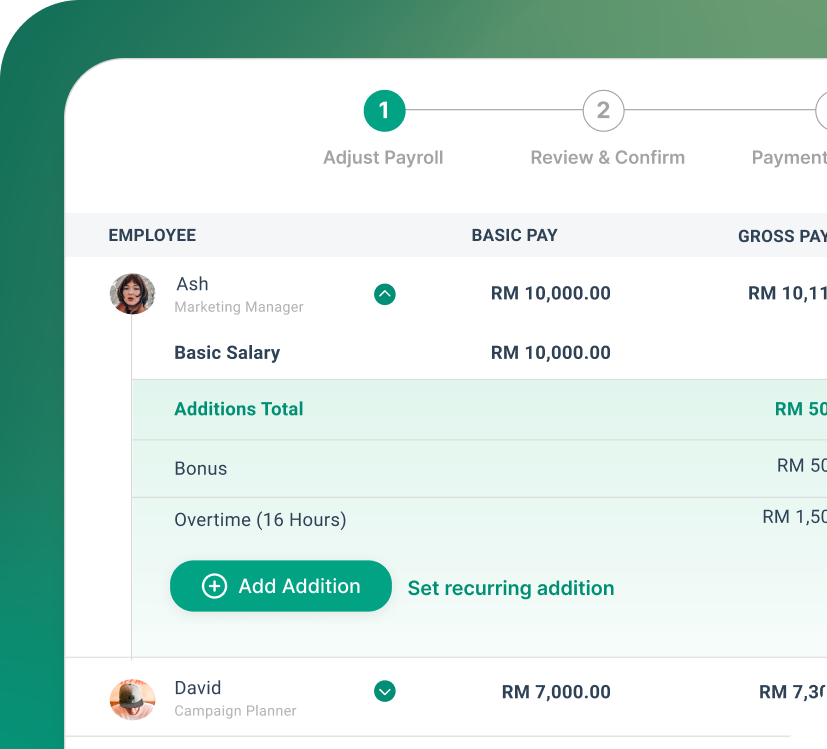
brioHR's payroll outsourcing service handles every step: monthly payroll runs, statutory submissions, salary disbursements, and real-time employee support. We're an extension of your team, not just a vendor.

When Should a Company Outsource Payroll?
Outsourcing isn't right for every business at every stage. Here are the situations where it makes the most practical sense.
- You're a startup without a dedicated HR team: Founders managing payroll manually risk errors and compliance gaps. It's one of the key reasons companies use HR software and outsourcing from day one
- Your payroll is crossing borders: Operating in multiple countries means navigating different labor laws, tax codes, and currencies, including Singapore Employment Pass rules and regional statutory differences
- You're scaling quickly: Rapid headcount growth, common in retail and F&B businesses with multi-cycle payrolls, strains internal processes fast
- You've had compliance issues: If your business has faced penalties for late statutory submissions or incorrect filings, a specialist provider reduces that risk significantly
- You're hiring internationally: Companies expanding into new markets can combine payroll outsourcing with an Employer of Record (EOR) setup for a seamless solution
- Your HR team is stuck in admin: If payroll is crowding out strategic work, HR automation combined with outsourcing frees capacity quickly
Types of Payroll Outsourcing Services
Payroll outsourcing models vary depending on how much responsibility the provider handles. Here are the three main options.
Full-Service (Managed) Payroll Outsourcing
The provider handles the entire payroll function end-to-end: calculations, filings, disbursements, reporting, and compliance.
Your team approves payroll runs and reviews reports. That's it.
This is the right choice for businesses that want to fully offload payroll complexity. brioHR offers flexible plans across team sizes and markets throughout ASEAN.
Partial Payroll Outsourcing
Your team handles some payroll tasks while the provider manages others.
A common setup: process payroll internally but outsource statutory submissions and tax filings to a specialist.
This works well for organizations with an existing payroll process that want targeted support in compliance-heavy areas, without handing over full control.
Global / Regional Payroll Outsourcing
For businesses operating across multiple countries, a global payroll provider consolidates everything into a single managed service.
This eliminates the complexity of coordinating separate local vendors in each market.
brioHR offers regional payroll outsourcing across Malaysia, Singapore, Indonesia, and beyond, with deep local compliance expertise built in for each market.
How Much Does Payroll Outsourcing Cost?
Payroll outsourcing is almost always more cost-effective than building an equivalent in-house team, once you factor in software, training, and the cost of compliance errors.
Pricing depends on company size, payroll frequency, geographic complexity, and scope of services. Common models include:
- Per Employee Per Month (PEPM): A fixed fee per employee, per month. Predictable and easy to budget. Scales with headcount changes
- Flat monthly fee: A single rate covering all payroll services regardless of employee count. Best for businesses with a stable headcount
- Tiered pricing: Pricing bands based on employee count or service scope. Per-employee costs typically decrease at higher volumes
- Custom enterprise pricing: For complex requirements like multi-country payroll, large headcounts, or specialized compensation structures, providers offer tailored pricing
Key cost factors include: number of employees, payroll run frequency, number of countries, and whether statutory disbursements are included.
Side note: Watch for hidden fees. Some providers charge extra for off-cycle payroll runs, employee terminations, or statutory filing amendments. brioHR uses transparent, no-hidden-fee pricing. No surprises.
The ROI of outsourcing extends beyond direct cost savings. It includes compliance risk reduction and internal capacity freed up to focus on growth.
See also: HR software costs and employee remuneration in Malaysia.
Best Payroll Outsourcing Providers: A Quick Overview
While many payroll tools exist, some providers offer full managed outsourcing services, handling compliance, disbursements, and employee support directly.
| Provider | Best For | Key Strength |
|---|---|---|
| brioHR | ASEAN businesses with 50+ employees | End-to-end managed payroll with local compliance expertise, 2-3 minute average support response time, and a team that acts as an extension of yours |
| ADP | Large enterprises with global operations | Comprehensive global payroll and human resources information system (HRIS) platform with broad country coverage |
| Papaya Global | Global companies with complex multi-country payroll | Unified global payroll and EOR in 160+ countries |
| Remote | Companies hiring internationally without local entities | Combined EOR and global payroll in one platform |
| Ramco | Multinational corporations in Asia | AI-powered multi-country payroll for large enterprises |
brioHR: Best for ASEAN Businesses That Want Payroll Fully Managed
Most payroll outsourcing providers hand you software and step back.
brioHR doesn't. It acts as an extension of your team, with local payroll specialists who manage every cycle, filing, and disbursement end-to-end, while you keep full visibility through the platform.
That combination of managed service plus integrated Human Resources Management System (HRMS) access is what sets it apart in the ASEAN region.

End-to-End Payroll Management
brioHR handles the full payroll cycle, from calculations and statutory contributions to bank file generation and salary disbursement.
Every step is managed by certified local payroll specialists, not automated and left unreviewed.
Deep Local Compliance Expertise
brioHR's in-house team covers statutory compliance across Malaysia, Singapore, Indonesia, and beyond.
That includes Employees Provident Fund (EPF), Social Security Organisation (SOCSO), Employment Insurance System (EIS), and Potongan Cukai Bulanan (PCB) in Malaysia, and Central Provident Fund (CPF) and Inland Revenue Authority of Singapore (IRAS) submissions in Singapore. Teams don't need to track regulatory changes themselves.
HRMS Access Included
Payroll outsourcing clients get full access to brioHR's HRMS platform at no extra cost.
Which means employees can view payslips, submit leave, and manage claims through a self-service portal, reducing the HR team's query load by up to 50%.
Support That Responds in Under 3 Minutes
brioHR's support team is made up of actual humans with local expertise in payroll, HR, and IT.
Average live chat response time is 2 to 3 minutes, with a client satisfaction rate above 97%.
Pricing
| Plan | Details |
|---|---|
| Model | Per employee per month |
| Structure | Modular, based on team size and scope |
| Customisation | Tailored to your headcount and markets |
Pro tip: brioHR uses transparent, no-hidden-fee pricing. Ask specifically about statutory disbursement fees, off-cycle runs, and amendment charges before signing with any provider.
Where brioHR Shines
- Full managed service: End-to-end ownership of every payroll cycle, not just software access
- ASEAN-first expertise: Deep compliance knowledge built natively for Malaysia, Singapore, Indonesia, and the broader region
- Integrated HRMS: Payroll, leave, claims, and employee data in one connected system
- Human support: Real specialists and real response times. No bots.
Where brioHR Falls Short
- Not the cheapest option for micro teams: Very small businesses that only need basic payroll may find the full platform more than they need
Customer Reviews
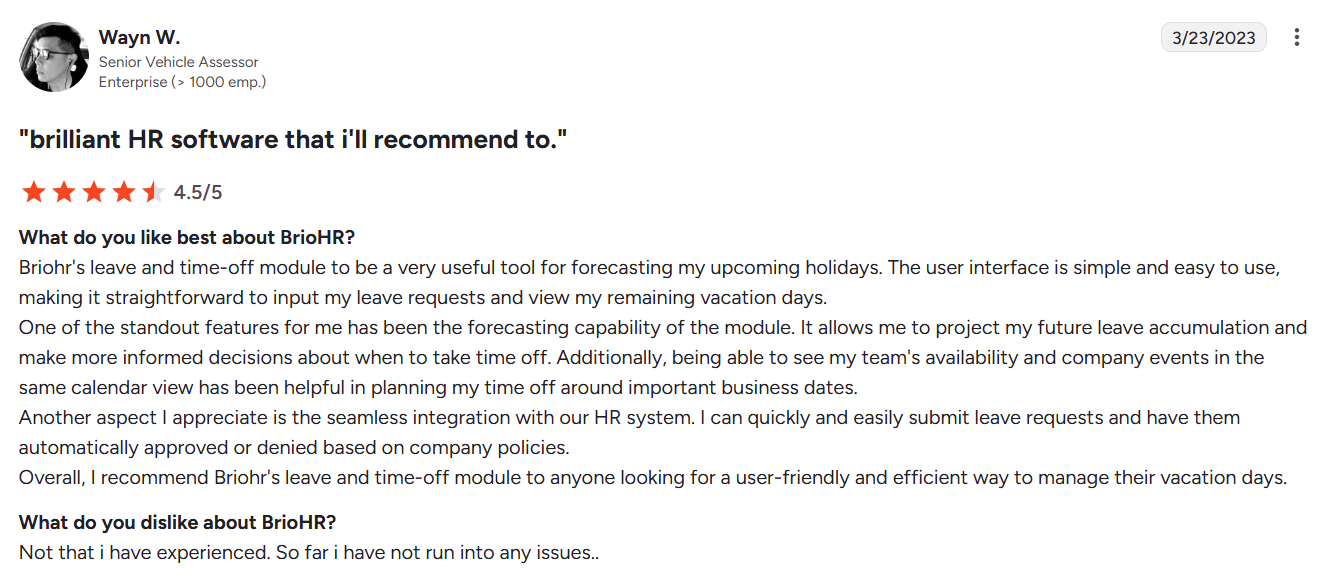
brioHR holds a 4.8-star rating on G2. Reviewers consistently highlight the responsive support team and the reduction in payroll processing time after switching from spreadsheets.

Who brioHR Is Best For
- ASEAN businesses with 50 or more employees
- Companies replacing fragmented payroll tools or manual processes
- Regional teams managing payroll across multiple ASEAN markets
- HR teams that want full managed outsourcing, not just software
👉 Explore brioHR's payroll outsourcing service
ADP: Best for Large Enterprises With Global Payroll Operations
ADP is one of the largest payroll and Human Resources Information System (HRIS) providers in the world.
For multinational corporations running payroll across dozens of countries, its global infrastructure is hard to match.

Key Features
Global Payroll Coverage
ADP processes payroll in 140+ countries, making it a genuine option for enterprises with truly global headcounts.
Integrated HRIS
ADP's platform connects payroll with broader HR functions including benefits administration, time tracking, and workforce analytics.
Enterprise-Grade Compliance
Regulatory updates are managed at scale across its global client base.
Where ADP Shines
- Extensive global country coverage
- Established reputation for large-scale enterprise payroll
- Broad suite of HR and workforce management tools
Where ADP Falls Short
- Pricing: ADP's enterprise plans carry significant cost, making them out of reach for most small or mid-sized businesses
- Implementation complexity: Large deployments can take months and often require dedicated project management
- ASEAN depth: Local compliance nuance in markets like Malaysia and Indonesia is less specialized compared to regional-first providers
Who ADP Is Best For
- Large enterprises (typically 500+ employees)
- Companies processing payroll across multiple continents
- Organizations that need a combined global payroll and HRIS platform
Papaya Global: Best for Companies With Complex Multi-Country Payroll
Papaya Global sits at the intersection of global payroll and Employer of Record (EOR) services.
If your business hires internationally without a local legal entity in every market, it's one of the few providers that handles both in one platform.

Key Features
Unified Global Payroll and EOR
Papaya Global manages payroll and employment compliance in 160+ countries through a single platform.
Contractor Management
In addition to full-time payroll, it supports contractor payments across multiple currencies.
Compliance Automation
Local employment laws, statutory contributions, and tax filings are handled centrally.
Where Papaya Global Shines
- Broad country coverage for businesses hiring in frontier markets
- Combined EOR and payroll reduces the need for multiple vendors
- Useful for companies expanding into new regions without a local entity
Where Papaya Global Falls Short
- Primarily built for global-first companies: Businesses focused on ASEAN may find regional specialists offer stronger local compliance depth
- Pricing reflects enterprise scope: Cost can be significant for smaller teams
- Less HRMS depth: Not a full HR management platform in the same way as ASEAN-native providers
Who Papaya Global Is Best For
- Global companies hiring across 10 or more countries
- Businesses that need EOR and payroll in a single managed service
- Teams entering markets where local entities aren't yet established
Remote: Best for Companies Hiring Internationally Without Local Entities
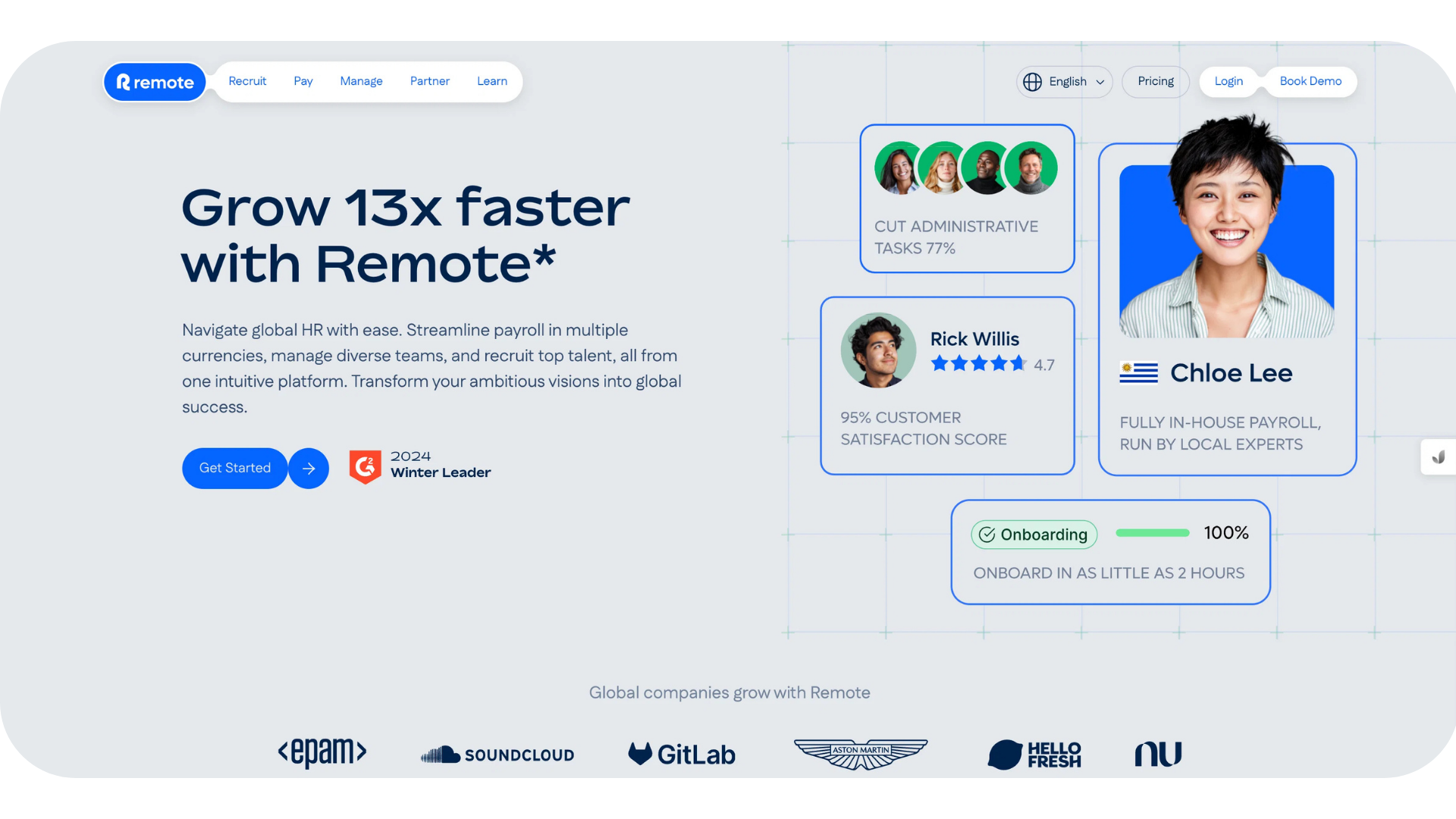
Remote is built for one specific problem: hiring people in countries where you don't have a legal presence.
Its combined EOR and global payroll platform means you can compliantly employ someone in a new market without setting up a local entity first.
Key Features
EOR in 180+ Countries
Remote acts as the legal employer for your international hires, handling local contracts, benefits, and compliance.
Global Payroll
For companies that do have local entities, Remote also offers managed payroll across multiple countries.
IP Protection
Remote includes intellectual property and invention assignment protections as part of its EOR agreements.
Where Remote Shines
- Strong EOR coverage for companies hiring their first employees in new markets
- Transparent, publicly available pricing (uncommon in this space)
- Clean, user-friendly platform experience
Where Remote Falls Short
- EOR is the core product: Companies that already have local entities and just need managed payroll may find better value elsewhere
- ASEAN compliance depth: Regional specialists with in-house local teams offer stronger on-the-ground expertise for markets like Malaysia and Singapore
- Less suited to large headcounts: Built for distributed and remote-first teams, not high-volume payroll operations
Who Remote Is Best For
- Startups and scale-ups hiring their first international employees
- Companies testing new markets before establishing a local entity
- Distributed teams with employees across multiple countries
Ramco: Best for Multinational Corporations Operating Across Asia
Ramco is an enterprise payroll platform built for large organizations operating across multiple countries in Asia and beyond.
Its AI-powered engine is designed to handle the complexity of high-volume, multi-entity payroll at scale.
Key Features
AI-Powered Payroll Processing
Ramco uses automation and machine learning to handle complex gross-to-net calculations across multiple jurisdictions.
Multi-Country Asia Coverage
Strong presence across Southeast Asia, South Asia, and the Middle East, making it relevant for large organizations with regional headquarters in Asia.
ERP Integration
Ramco integrates with enterprise resource planning (ERP) systems, which is useful for large finance and operations teams.
Where Ramco Shines
- Well-suited to large-scale multi-country payroll in Asia
- AI-driven automation reduces manual processing for complex payroll structures
- Strong compliance coverage across Asian markets
Where Ramco Falls Short
- Enterprise-focused: Not designed for small or mid-sized businesses, with complexity and cost that reflect an enterprise buyer
- Implementation demands: Like most enterprise platforms, setup requires significant time and internal resources
- Less accessible for growing SMEs: Companies scaling from 50 to 300 employees will likely find more practical options elsewhere
Who Ramco Is Best For
- Multinational corporations (typically 1,000+ employees)
- Large organizations running high-volume payroll across Asia
- Businesses already using enterprise-grade systems that need a compatible payroll layer
How to Choose the Right Payroll Outsourcing Provider
Not all providers are equal. Here are the criteria that matter most, and the mistakes to avoid with each.
Local Compliance Expertise
Statutory requirements differ by country and change regularly.
Your provider must have proven, in-country expertise, not just general knowledge of international payroll.
Tip: Ask specifically how the provider tracks regulatory changes in each of your markets. Do they have in-house local specialists, or do they rely on third parties? Vague answers are a red flag.
Transparent Pricing
Hidden fees are one of the most common complaints about payroll providers.
Termination fees, amendment charges, and off-cycle run costs can significantly inflate actual spend.
Tip: Before signing, request a full list of billable events beyond the base fee. Ask what happens when an employee leaves or when you need an off-cycle run.
Data Security Standards
Payroll data includes some of the most sensitive personal and financial information your business holds.
Your provider must demonstrate robust security practices, not just claim them.
Tip: Ask for certifications: SOC 2, ISO 27001, or General Data Protection Regulation (GDPR) compliance. Review brioHR's security practices and our guide to securing HR data.
Customer Support Quality
Payroll issues are time-sensitive. A provider with slow support can turn a minor error into a delayed salary run.
Tip: Test responsiveness before committing. Ask about response times, support channels, and whether you get a dedicated account manager. brioHR's average response time is under three minutes via live chat. Human experts, no bots, with a client satisfaction rate above 97%.
Integration Capabilities
Your payroll system needs to work with your existing HRMS, time tracking, and accounting tools.
Poor integration means manual data entry and higher error risk.
Tip: Confirm what integrations are available out of the box and whether an API option exists. Use our HRMS evaluation checklist to assess fit before committing.
See also: brioHR customer stories | Contact us
Take the Complexity Out of Payroll with brioHR
Payroll shouldn't be the thing that holds your HR team back.
brioHR's fully managed payroll outsourcing service covers monthly payroll runs, statutory submissions, salary disbursements, and real-time employee support across Malaysia, Singapore, Indonesia, and beyond.
We act as an extension of your team: local experts, transparent pricing, client satisfaction above 97%, and human support that responds in under three minutes.
When payroll just works, your HR team can focus on the work that actually matters.
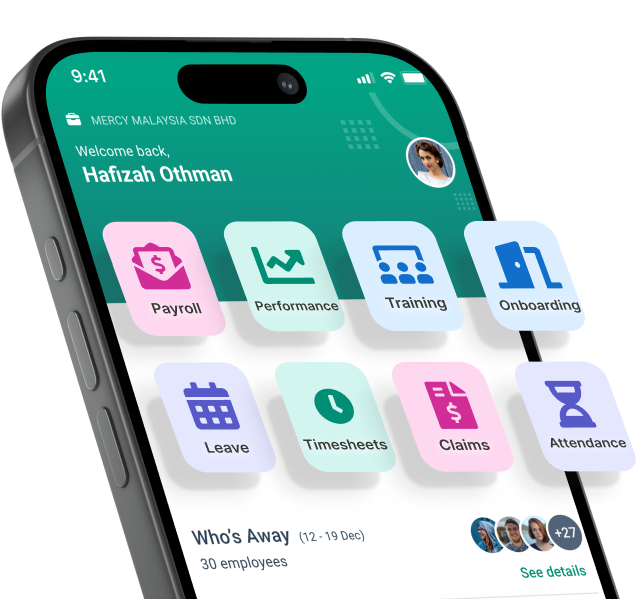
Everything HR.
One login
From payroll to onboarding, brioHR gives you everything you need in one place. Built for busy teams. Backed by people who care.
Conclusion
- Eliminate Admin Noise: Handing operations to specialists frees your HR team to focus entirely on growth and strategy.
- Mitigate Compliance Risks: Ensure your statutory contributions and tax filings stay accurate as local regulations change.
- Lower Operational Costs: Replace expensive in-house payroll divisions and software overhead with a predictable fee.
- Improved Accuracy: Automated systems reviewed by experts reduce expensive payroll errors and payroll run delays.
- Seamless Scalability: Easily adapt to rapid headcount growth or regional expansion without adding internal headcount.