Best Automated Payroll Software to Save Time (2026 Reviewed)

Key Takeaways
- brioHR is the best automated payroll software for SMEs and mid-market companies in Malaysia and Singapore that want payroll connected to leave, claims, attendance, and HR in one system, with the option to outsource payroll entirely.
- Kakitangan is the best fit for cost-conscious Malaysian small businesses that need affordable, locally compliant payroll without a full HRMS.
- QuickHR is best for Singapore-first SMEs that want native CPF payroll plus structured daily HR and ISO 9001 credibility.
- Workday is reserved for large global enterprises that can absorb its cost and 12-to-24-month rollout.
Manual payroll is where small mistakes turn into expensive problems. A wrong deduction, a missed statutory filing, or a leave balance that never made it into the pay run creates compliance risk, frustrated employees, and hours of rework every month. Automated payroll software removes that risk by calculating salaries, taxes, and contributions automatically and syncing them with the rest of your HR data. The good news for teams in Malaysia and Singapore is that strong local and regional tools already exist, so you don't need to settle for a global system built for someone else's tax rules. This article compares the features, pricing, payroll capabilities, and best-fit use cases of eight options so you can choose with confidence.
Best Automated Payroll Software in 2026: A Quick Look
| Software | Best For | Standout Feature | Price Starting Point |
|---|---|---|---|
| brioHR | All-in-one payroll and HR (MY/SG) | Payroll synced to leave, claims, and attendance, plus payroll outsourcing | From RM3 per employee per month |
| Kakitangan | Cost-focused Malaysian SMEs | Fully localized Malaysian statutory payroll | Custom, based on headcount and modules |
| Swingvy | SMEs starting HR automation | Modern, mobile-first payroll and self-service | From RM10 per employee per month |
| QuickHR | Singapore SMEs standardizing HR | Native CPF payroll, ISO 9001:2015 certified | From S$5 per employee per month |
| Employment Hero | HR-first teams wanting breadth | Wide HR ecosystem with self-service | From USD $10 per employee per month |
| HReasily | Cross-border MY and SG teams | Dual MY and SG payroll, mobile-first | From RM4 per employee per month |
| altHR | Malaysian SMEs wanting performance too | MY payroll plus a real performance suite | From RM8 per employee per month |
| Workday | Large global enterprises | End-to-end global HCM and payroll | Custom enterprise pricing |
Payroll rarely stays "just payroll." It quickly touches leave, claims, attendance, employee data, and reporting, which is exactly where most standalone tools start to break down. If you want a single system that handles all of it with local compliance built in, brioHR's payroll software is the most complete option on this list.
"When payroll runs smoothly and employees get paid accurately and on time, it contributes to a more positive work environment"
brioHR: Best for All-in-One Payroll and HR Automation

brioHR is an all-in-one HRMS and payroll platform built for companies in Malaysia and Singapore that want one system across the full employee lifecycle. More than 1,000 organizations across 50 countries use it. Instead of treating payroll as a standalone function, brioHR connects it to time tracking, leave, claims, and employee records, which removes the manual reconciliation that causes most payroll errors.
brioHR Key Features
brioHR brings together the tools HR and finance teams need to run payroll accurately and on time, without stitching together exports from three different systems. Here's where it stands out for payroll specifically.
Stand Out Feature #1: Payroll That Syncs Automatically
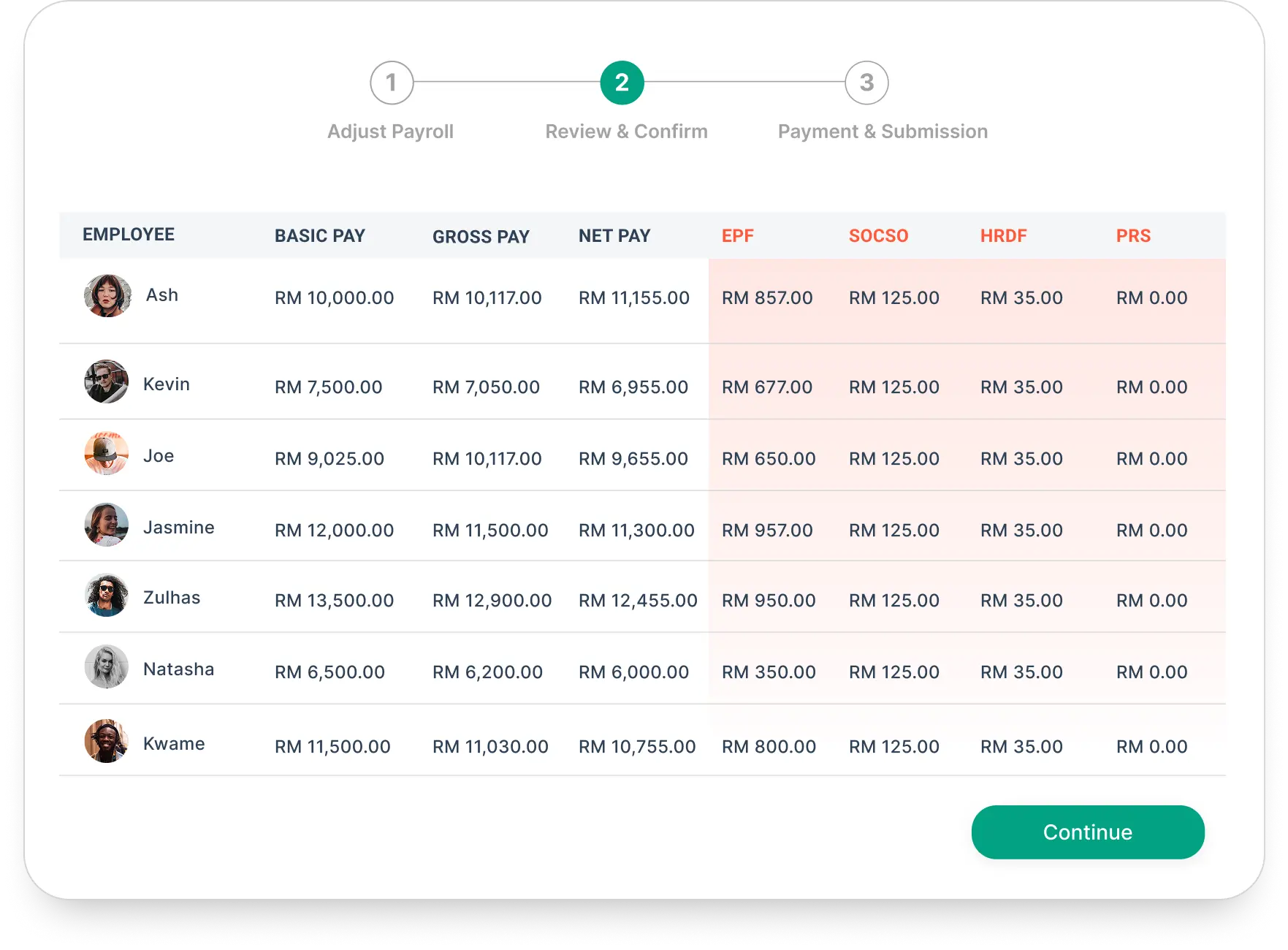
Attendance, leave, and claims flow directly into payroll, so there are no manual uploads and no reconciliation errors before cut-off. When an employee takes unpaid leave or submits an approved claim, it's already reflected in the pay run, which removes the export-and-reupload step where most spreadsheet errors creep in. brioHR also supports monthly, weekly, and shift-based cycles, so retail, food and beverage, and operations-heavy teams can run pay the way they actually operate rather than forcing everyone onto one rigid cycle. Every run leaves a single audit trail, which makes month-end checks and year-end statutory filing far easier to verify. The pieces connect through brioHR's time and attendance and leave and time off modules, all feeding the same digital employee file, so payroll, HR, and finance are always working from one source of truth.
Stand Out Feature #2: Native Malaysian and Singapore Compliance

brioHR handles statutory payroll natively in both markets, not through a partner or a configuration workaround. For Malaysia, that covers EPF, SOCSO, EIS, PCB, and HRD Corp calculations, plus statutory forms like EA, CP39, Form E, and CP8D with LHDN-ready filing and bank files. For Singapore, it covers CPF, SDL, IR8A, and IR21 in line with IRAS and MOM requirements. The advantage of a native payroll automation system is that statutory updates roll out automatically, so when contribution rates or tax brackets change, your pay runs stay correct without anyone editing a formula. That matters in two markets with separate, frequently updated rules, where a single missed change can trigger penalties and back-payments. See the full breakdown on brioHR's payroll software and Singapore payroll pages, and stay current through its CPF updates resources.
Stand Out Feature #3: Payroll Outsourcing When You Need It
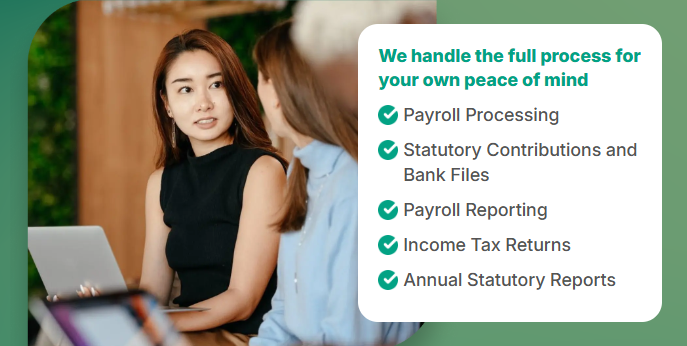
This is brioHR's clearest differentiator. It's the only platform on this list that offers both payroll software and a managed payroll outsourcing service, plus support for Employer of Record and global payroll. If your team is too lean to run payroll in-house, brioHR's specialists can run it for you on the same platform your data already lives in, so you keep full visibility instead of handing everything to an outside bureau. If you're hiring across borders, the same setup extends to EOR and global payroll without a separate vendor. The practical benefit is that you're not forced to migrate systems as your needs change: you can start with software, switch to managed payroll during a busy stretch or a key hire's departure, and move back, all without re-implementing. For most tools on this list, outsourcing simply isn't an option. Learn more about brioHR's payroll outsourcing services.
brioHR Pricing
| Plan | Details |
|---|---|
| Payroll module | From RM3 per employee per month (from S$2 in Singapore) |
| Model | Modular, per-employee pricing based on team size and the modules you select |
| Custom quote | Tailored to headcount, workflows, and rollout needs |
brioHR is PSG-eligible for Singapore SMEs. You can review options on the Singapore pricing plans page.
Where brioHR Shines
One platform for all of HR: Payroll, leave, claims, attendance, performance, and reporting all sit in one connected system. There's no tool-stitching, no double entry, and no month-end reconciliation headache.
Local compliance handled properly: EPF, SOCSO, EIS, LHDN, CPF, SDL, IR8A, and IR21 workflows are all native, with automatic statutory updates. brioHR pairs this deep local coverage with cloud infrastructure and ISO 27001 data security.
A partner, not just software: brioHR reports sub-three-minute support response times and a 96% positive feedback rate. That matters most during payroll week, when a delay costs real money. Implementation averages around two months, compared to six or more for global alternatives.
Where brioHR Falls Short
Better as a long-term investment than a quick fix: brioHR is built for teams committing to a proper HR and payroll system, not a temporary or single-purpose setup.
More than a solo operator needs: The platform is designed for companies with real HR and payroll complexity, so very small teams may not use enough of it to justify the move.
brioHR Customer Reviews
brioHR holds 4.7 stars from 31 verified reviews on G2 and 4.9 stars from 57 reviews on Capterra. Reviewers consistently highlight easy implementation, strong analytics, and responsive support. One CEO wrote that they "found BrioHR to be very comprehensive and configurable," while a software reviewer on Capterra noted the platform "makes handling payroll, leave, and employee data easy and efficient" without feeling overwhelming.
Automotive
Who brioHR Is Best For
Growing SMEs: Teams replacing spreadsheets or several disconnected payroll, leave, and claims tools.
Mid-sized companies in MY and SG: Businesses that need native compliance, automation, and stronger reporting in one system.
Regional and lean teams: Companies operating across Malaysia and Singapore, including those that would rather outsource payroll than build it in-house.
See brioHR in action. Book a free demo → or explore real customer stories.
Kakitangan: Best for Cost-Focused Malaysian SMEs

Kakitangan is a Malaysia-focused payroll and HR platform built around local workflows. Its strength is local fit and affordability, making it a practical choice for small businesses that prioritize Malaysian payroll accuracy over broad HR capability.
Key Features
Localized Payroll Processing
Salary calculations, payslips, and full statutory submissions including EPF, SOCSO, EIS, PCB, HRDF, EA Form, and LHDN e-filing.
Connected Claims and Leave
Receipt photo upload, AI OCR for expense capture, multi-level claim approval, mileage tracking, and reimbursement linked directly into payroll calculations.
Mobile-First Attendance
Mobile GPS clock-in, geo-fencing, and overtime tracking suit field, retail, and shift-based teams.
Pricing
| Plan | Details |
|---|---|
| Payroll pricing | Based on number of staff and modules selected (budget tier) |
Where Kakitangan Shines
Genuinely affordable: One of the lower-cost options for Malaysian small businesses, with full statutory coverage out of the box.
Fast to roll out: Implementation typically takes about a month, ideal for teams moving quickly off spreadsheets.
ISO 27001 certified: A clear focus on data security and local compliance.
Where Kakitangan Falls Short
Not a full HR system: No recruitment, onboarding, performance management, or learning modules.
Limited scalability: No multi-entity support, SSO, or API access, which becomes a constraint past roughly 100 employees.
Inconsistent support: Some users report slower response times during critical payroll moments.
Customer Reviews
Reviews highlight affordability and helpful guidance, with one user calling it "affordable and easy to use for small teams." On the other side, some reviewers flag feature limitations and slower support as the business grows.
Who Kakitangan Is Best For
Small Malaysian businesses: Teams with simple payroll and claims needs.
Cost-conscious companies: Businesses prioritizing budget over feature breadth.
Swingvy: Best for SMEs Starting HR Automation
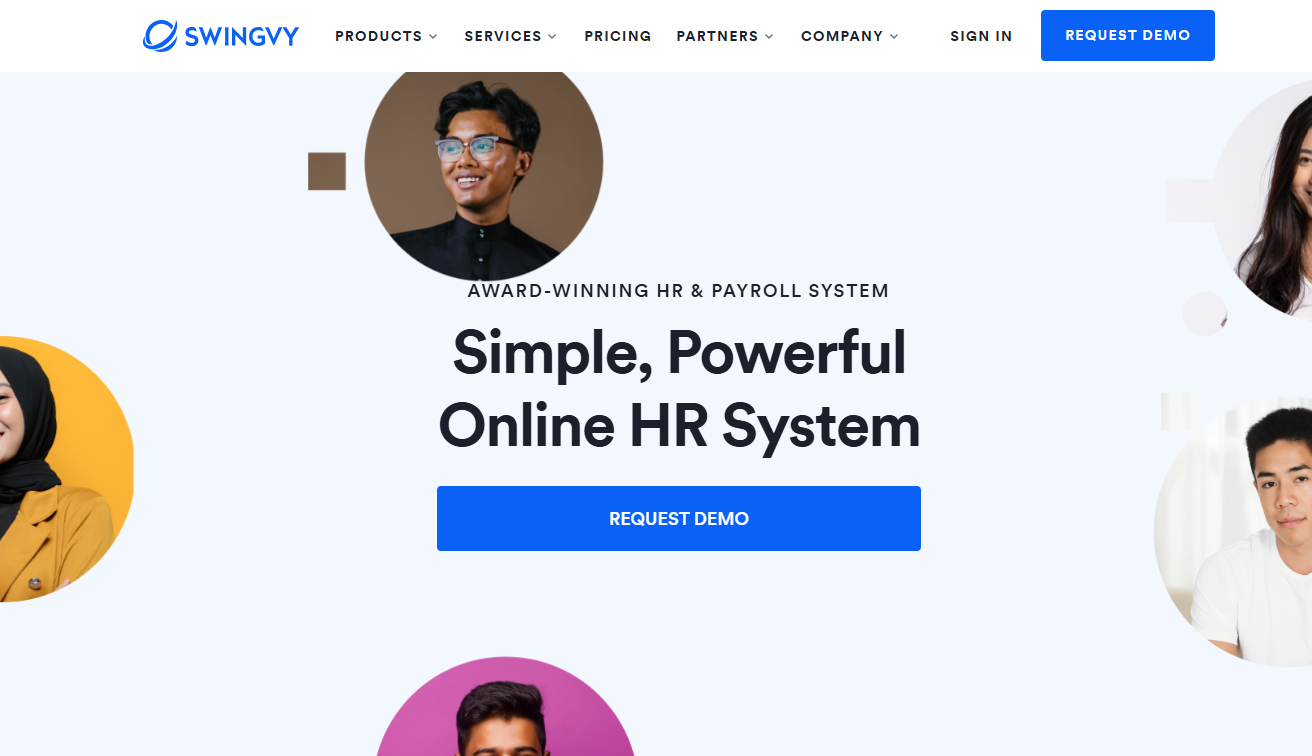
Swingvy combines payroll and core HR admin in a clean, modern package. It's usually chosen by SMEs that want to move off spreadsheets without stepping straight into a heavier platform, with usability and mobile access as its main draw.
Key Features
Core Payroll and Compliance
Payroll with full Malaysian statutory support (EPF, SOCSO, EIS, PCB, HRDF, LHDN) and Singapore workflows (CPF, SDL, IR8A).
Employee Self-Service
A mobile-first experience for leave, claims, and clock-in that drives adoption across teams.
Practical Attendance
Mobile GPS clock-in, geo-fencing, and shift scheduling for distributed and shift-based teams.
Pricing
| Plan | Details |
|---|---|
| Modular pricing | From RM10 per employee per month |
Where Swingvy Shines
Modern, mobile-first experience: The apps make leave, claims, and attendance feel easy, which helps company-wide adoption.
Solid day-to-day HR coverage: Leave, claims, attendance, and core payroll live in one place.
Clean UX: Independent comparisons rate the interface around 4.0 out of 5.
Where Swingvy Falls Short
No recruitment or ATS: Job posting, resume parsing, and offer letters need separate tools.
Light performance and L&D: Beyond basic reviews, there's no OKR, 360 feedback, or training records.
No payroll outsourcing: Not built for managed payroll or cross-border teams.
Customer Reviews
Reviewers consistently praise the clean interface and mobile access. One positive theme is ease of adoption across non-technical staff. On the negative side, support feedback is more mixed, and review volume is relatively small.
Information Technology and Services
Who Swingvy Is Best For
SMEs starting HR automation: Teams replacing spreadsheets for the first time.
People-first teams: Companies that care about usability and employee experience.
QuickHR: Best for Singapore SMEs Standardizing HR Operations

QuickHR is a Singapore-first HR platform with broader module coverage than most payroll-only tools. Its ISO 9001:2015 certification adds credibility for procurement teams with stricter audit requirements.
Key Features
Singapore-Native Payroll
Full CPF, SDL, IR8A, and IR21 support, with multi-currency payroll and PSG eligibility for Singapore SMEs.
Broad Daily HR Coverage
Leave, claims, attendance, timesheets, document management, and contract management with multi-level approval flows.
Mature Reporting
A custom report builder, people analytics, and headcount dashboards, which is unusual at this price tier.
Pricing
| Plan | Details |
|---|---|
| Modular pricing | From S$5 per employee per month, custom quote by size and modules |
Where QuickHR Shines
Native Singapore payroll: Reliable CPF and statutory handling with PSG eligibility.
Strong shift-based attendance: GPS clock-ins, geo-fencing, rotating shifts, and automated overtime.
ISO 9001:2015 certified: Helpful for compliance-sensitive procurement.
Where QuickHR Falls Short
Malaysian payroll runs through a partner: EPF, SOCSO, EIS, and EA Form support is partial rather than fully native.
No recruitment, onboarding, or performance modules: Core talent workflows are absent.
Light engagement tools: No pulse surveys, recognition, or internal communication features.
Customer Reviews
Positive reviews frequently praise the responsive support team and quick setup. A common critique is that the interface feels functional rather than intuitive, and that workflows can be harder to customize as needs evolve.
Security and Investigations
Who QuickHR Is Best For
Singapore SMEs standardizing HR: Process-driven teams that value structure.
Audit-sensitive companies: Businesses that need ISO credibility for procurement.
Employment Hero: Best for HR-First Teams Wanting Breadth

Employment Hero is an HR and payroll platform built around a wide employee engagement and HR ecosystem. It's best suited to companies that want payroll as part of a broader HR stack rather than a tightly integrated, payroll-first system.
Key Features
Wide HR Ecosystem
Recruitment, onboarding, performance, payroll, and engagement, which is more horizontal coverage than most SME-focused platforms.
Employee Self-Service
A strong self-service portal that reduces routine admin.
Recognition and Surveys
Pulse surveys and recognition features that few tools in this list include.
Pricing
| Plan | Details |
|---|---|
| HR Premium | From USD $10 per employee per month, subject to a USD $100 minimum monthly contract |
| Malaysia guidance | Around RM8 to RM12 per employee per month |
Where Employment Hero Shines
Feature breadth: Genuinely wide coverage across the employee lifecycle.
Modern employee experience: Clean UI and engagement tools score around 4.0 out of 5 for usability.
Where Employment Hero Falls Short
Payroll and HR not fully unified: Payroll was acquired separately and requires a separate login.
Weaker MY and SG localization: Local support depth and compliance coverage can be inconsistent, and implementation often takes around six months.
Customer Reviews
Employment Hero holds 4.4 out of 5 on Capterra from 239 reviews. A positive review notes the platform "makes managing HR tasks much more efficient," while a negative review reports that "the employee portal appears to be malfunctioning."
Information Technology and Services, 11–50 employees
Who Employment Hero Is Best For
HR-first organizations: Teams that want a broad platform with payroll bundled in.
Teams centered in Australia or the UK: Where its localization and support are strongest.
HReasily
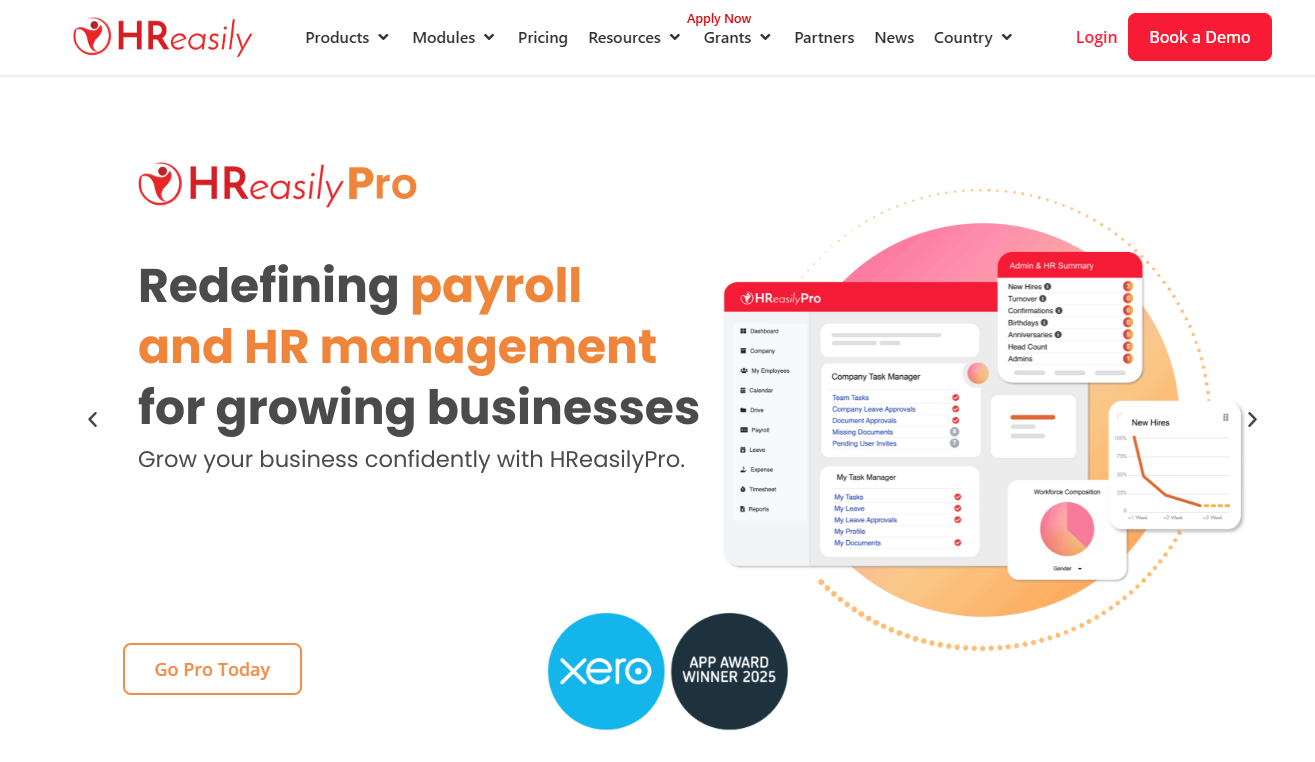
HReasily is a cloud-based HR and payroll platform serving SMEs across Malaysia and Singapore. It covers automated payroll, claims, and time attendance through a mobile-first interface, with native statutory compliance in both markets (EPF, SOCSO, CPF, and SDL). That dual coverage makes it useful for lean cross-border teams that want payroll and expense automation without heavy setup. Pricing starts from RM4 per employee per month. The trade-off is depth: there's no recruitment, performance management, or learning and development, and reporting is fairly basic, so larger teams may find it lightweight. It's a strong fit for mobile-first SMEs that prioritize on-the-go access over a full HR suite.
altHR
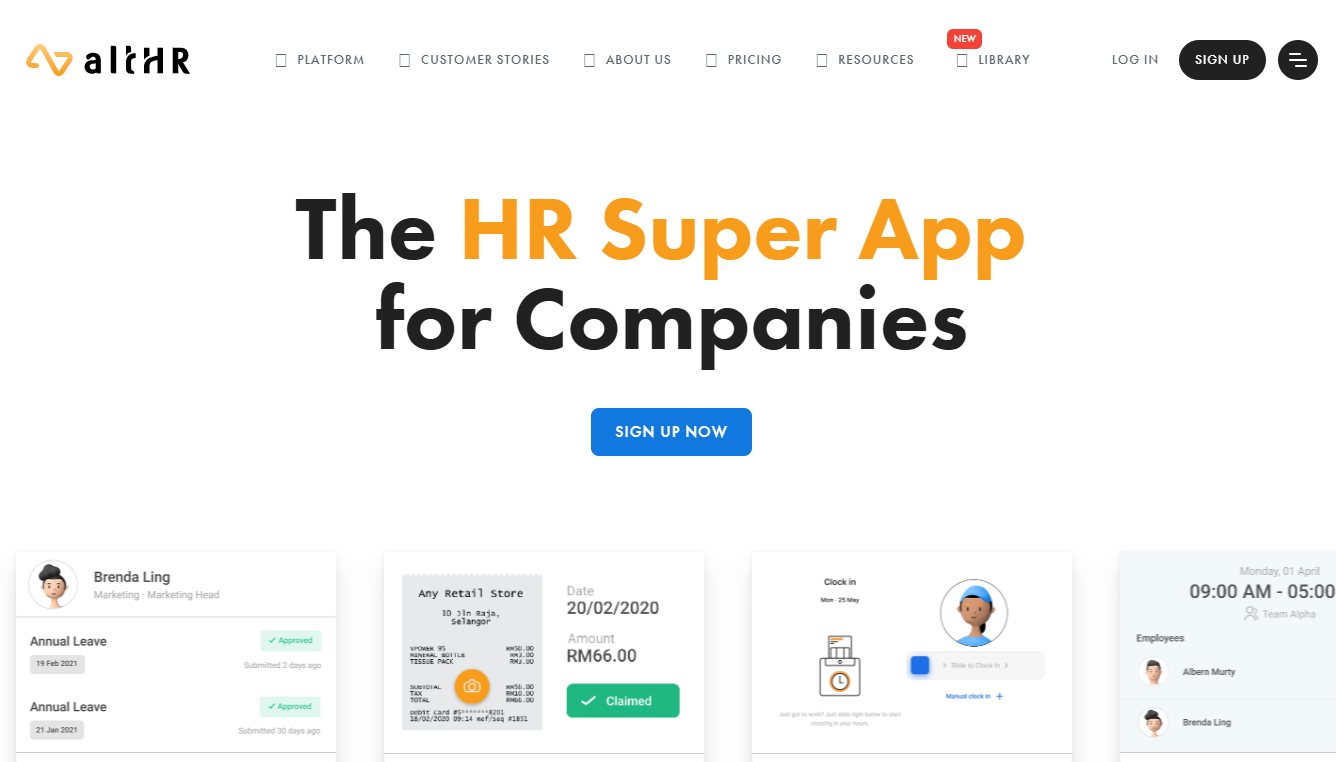
altHR, by CelcomDigi, is a Malaysian platform that pairs core payroll, leave, and claims with a genuinely built-out performance suite, including OKRs, KPI tracking, 360 feedback, and performance dashboards. It also offers solid onboarding workflows and advanced role permissions, with full Malaysian statutory coverage (EPF, SOCSO, EIS, PCB, HRDF) and religious leave types. Pricing starts from RM8 per employee per month. The main limitation for cross-border teams is that altHR has no Singapore payroll support, so companies with Singapore headcount will need additional tools. It also lacks recruitment and payroll outsourcing. Reviewers on Capterra single out the depth of the performance module as a real differentiator over more payroll-only local tools.
Workday

Workday is a full enterprise Human Capital Management platform trusted by Fortune 500 companies globally. It covers payroll, recruitment, onboarding, performance, learning and development, analytics, and workforce planning across multi-entity, multi-currency, and multi-language operations, with almost no feature gaps. For most Malaysian and Singaporean SMEs, though, it's overkill. Pricing often starts around USD $35 per employee per month and can reach six figures annually, implementation typically takes 12 to 24 months, and Malaysian and Singapore payroll are configured rather than native (EA Form and LHDN e-filing are only partially supported). There are no dedicated local support hours, which creates friction during regional payroll cut-offs. It's best reserved for large enterprises with 10,000 or more employees and dedicated HRIS and IT teams.
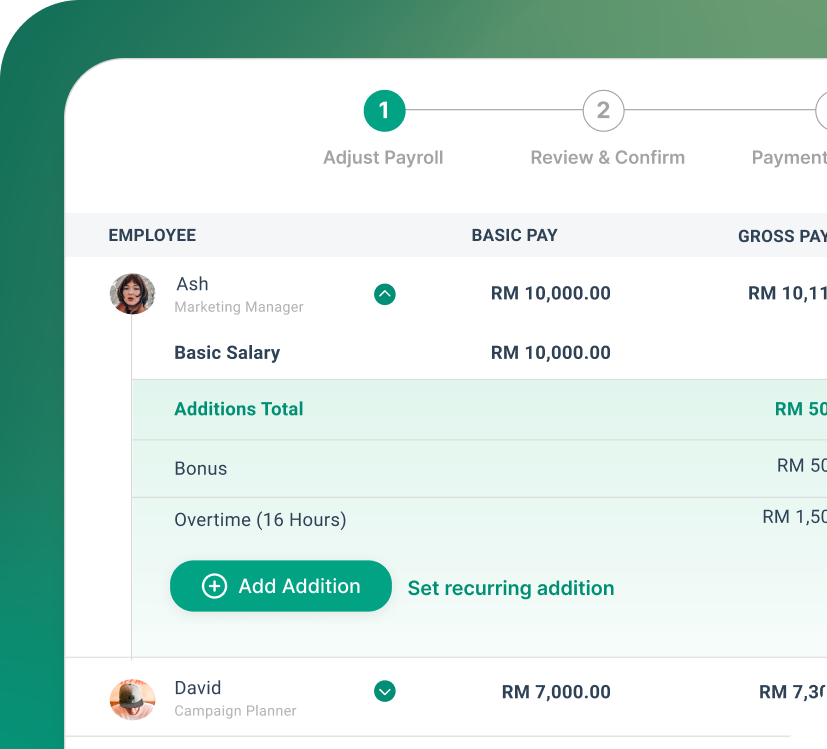
Experience how simple payroll can be
Reduce processing time and compliance risks with brioHR's intuitive payroll system.
"A well executed and error free payroll strategy can improve retention, boost morale, and reflect the values of your organization."
How to Choose the Best Automated Payroll Software
The right tool depends on where you operate, how complex your payroll is, and how much of HR you want in one place. Adoption is no longer the question: by 2025, an estimated 80% of companies had moved to automated payroll systems, and over three-quarters now use some form of AI in payroll and benefits administration. The harder question is which payroll automation software actually fits your market, your team size, and your compliance load. These are the considerations that matter most when comparing an automated payroll system.
Feature Consideration #1: Native Statutory Compliance

Your payroll software should calculate and file local contributions automatically, then update itself when rates change. In Malaysia that means EPF, SOCSO, EIS, PCB, and HRD Corp, with EA, Form E, and LHDN e-filing. In Singapore it means CPF, SDL, IR8A, and IR21. The key question is whether compliance is native or delivered through a partner, because partner-based coverage often means slower turnaround when rules change. brioHR handles all of these natively in both markets and pushes statutory updates automatically. For more, see brioHR's guide on what to look for in HR software.
See brioHR in action. Book a free demo →
Feature Consideration #2: Integration With the Rest of HR

Payroll is only as accurate as the data feeding it. If attendance, leave, and claims live in separate tools, someone has to export and re-enter them every cycle, which is where errors and reconciliation hours pile up. Look for a system where approved leave, overtime, and claims flow straight into the pay run. brioHR connects all of this to the digital employee file and HR reporting software, so a merit review or an audit pulls from one source instead of three. Read more in brioHR's piece on how payroll software saves money.
Feature Consideration #3: Support and Local Presence

When payroll cut-off is hours away, support speed is not a nice-to-have. Global platforms often run on timezones that don't match Malaysia or Singapore, so a question on payroll night can sit until the next business day. Check published response times, local support hours, and whether the vendor offers a payroll outsourcing backup if your team is stretched. brioHR's sub-three-minute response times, 96% positive feedback rate, and managed payroll outsourcing services are built for exactly these moments.
If native compliance, connected data, and fast local support are the gaps you're trying to close, you can see how brioHR handles all three in a short demo. For more guidance, see brioHR's resources on choosing HR software in Singapore and justifying the cost of HR software.
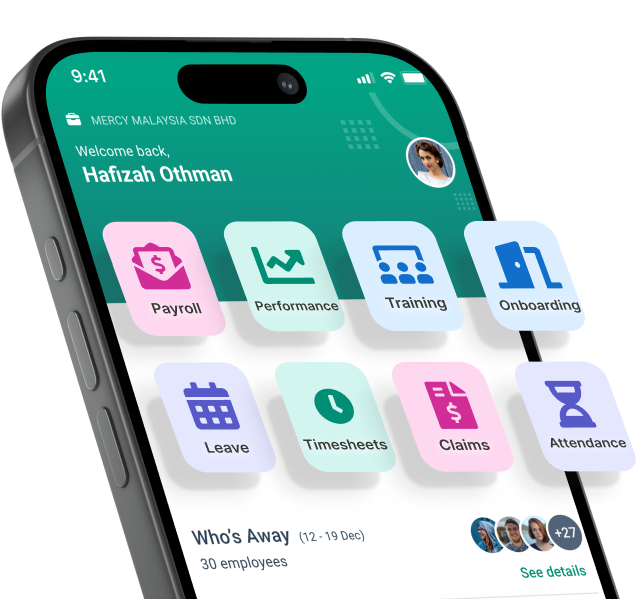
Everything HR.
One login
From payroll to onboarding, brioHR gives you everything you need in one place. Built for busy teams. Backed by people who care.
Simplify Payroll and HR Management With an All-in-One Platform Like brioHR
Payroll automation isn't all-or-nothing. Even targeted automation around calculations, approvals, and compliance checks can meaningfully cut risk and reclaim hours every month. If you only need basic Malaysian payroll on a tight budget, Kakitangan or HReasily may be enough, and if you're a large global enterprise, Workday will fit. But for most growing SMEs and mid-market teams in Malaysia and Singapore that want payroll, compliance, leave, claims, and HR in one connected system, with the option to outsource when needed, brioHR is the most complete choice. The next step is simple: see it run with your own numbers.
Ready to stop fixing payroll and start running it with confidence? Request a demo → or learn about brioHR's managed payroll services.
Conclusion
- brioHR is the most complete automated payroll option for SMEs and mid-market teams in Malaysia and Singapore, with native compliance, connected HR, and the option to outsource.
- Kakitangan and HReasily suit teams with basic Malaysian payroll needs on a tight budget.
- QuickHR is the strongest pick for Singapore-first SMEs that need native CPF payroll and ISO audit credibility.
- Workday remains the right choice only for large global enterprises with dedicated HRIS and IT teams that can absorb its cost and implementation timeline.
Ready to simplify your payroll? Book a free brioHR demo →