Why Training Activity Doesn’t Always Lead to Performance
Key Takeaways
- Training activity doesn’t equal performance, because learning without application doesn’t change anything.
- Most training fails at the transfer stage, when people go back to work and nothing supports the new behavior.
- Without clear context, employees don’t know when or how to use what they learned.
- Manager support matters more than the training itself, because behavior change needs reinforcement.
- If performance doesn’t improve, the problem isn’t more training, it’s how the work environment is set up.
Many HR and L&D teams run dozens of training sessions every year.
The question is: Was the training useful, or was it just 'another' activity?

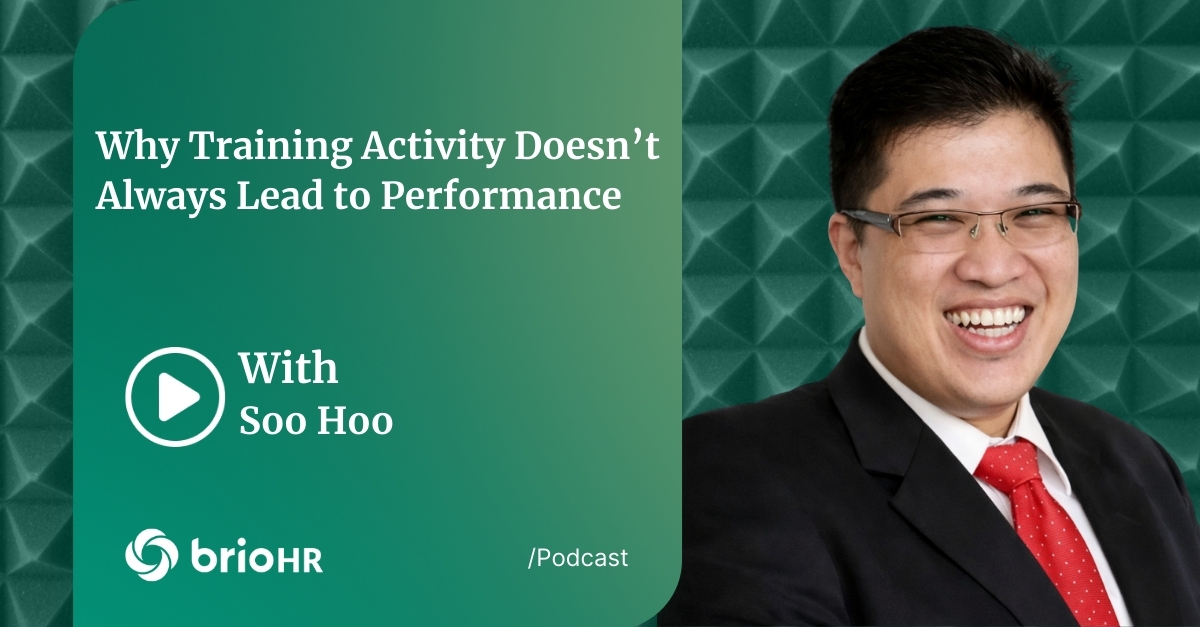
In Episode 10 of withBrio, Soo Hoo shared a perspective that many HR leaders quietly agree with but rarely say out loud. Training should not exist to fill a learning calendar. It should change how people actually work. After more than 17 years coaching professionals across different industries and countries, Soo Hoo has seen the same pattern repeatedly. Organisations don’t struggle because they lack training programs. They struggle because those programs rarely translate into behaviour.
When Training Feels Like Another Work Task
Soo Hoo pointed out is that many employees attend training because they have to. They sit through the session, take notes, maybe even enjoy the discussion. But once they return to work, the habits of the organisation take over again. This is why traditional lecture-style training often fails. Listening to a concept is very different from applying it under pressure at work. Soo Hoo approaches training differently. Instead of focusing only on knowledge, he designs environments where participants must practice decisions, communication, and leadership behaviours. Sometimes that even means changing the learning environment entirely.
Why the 2-Day Workshop Model Is Losing Relevance
For years, organisations relied on the familiar format: a two-day workshop where employees step away from work, learn a framework, and return to their roles. But that format is becoming harder to sustain. Attention spans are shorter. Work schedules are tighter. Younger professionals expect learning to be flexible. Instead of long sessions, many organisations are experimenting with shorter modules delivered across months. Two to four hours at a time, with opportunities to apply what was learned between sessions. In practice, this often leads to better retention because learning becomes part of daily work rather than a separate event.
Practice is the hardest part of learning, and training is the essence of transformation
Why Workforce Planning Is No Longer About Employees Only
Dr. Diez also argues that HR thinking is often stuck in an outdated model of work. In many organisations today, work is done by a mix of full time employees, contractors, freelancers, project teams, software, automation, and AI systems. Treating workforce planning as “headcount management” no longer reflects reality. This is why he suggests that the function may eventually evolve into something closer to a Chief Resources Officer role. Someone responsible for managing human and non human resources as one integrated system. This is also why AI adoption cannot be left only to IT. Introducing automation changes how people see their future, their value, and their security. Managing that transition is primarily a trust and psychology challenge.
Measuring Whether Training Actually Works
Another issue Soo Hoo raised is how organisations measure training. Most programs are evaluated using participant feedback. People rate the session, comment on the facilitator, and HR records the satisfaction score. But satisfaction does not necessarily mean behaviour changed. In the Kirkpatrick evaluation model, Levels 3 and 4 look beyond the classroom. They ask whether participants apply the skills at work and whether those changes improve organisational outcomes. That requires something many organisations rarely track: what happens after the training. Are managers using the tools they learned? Are teams communicating differently? Did productivity actually improve? Without that follow-up, training remains difficult to justify beyond the initial experience.
Turn training into real performance
Track progress, reinforce learning, and make sure it actually shows up in day-to-day work.

The Generational Shift HR Is Navigating
Another topic discussed was the growing difference in career expectations across generations. Earlier generations often stayed with an organisation for decades before reconsidering their career direction. Today, younger professionals may reassess their role much earlier if they feel their growth has stalled. This does not necessarily mean they lack commitment. It often reflects a different view of career development. Many employees now prefer to build their own progression by acquiring new capabilities rather than waiting for promotions to define their path. For HR teams, this means development programs need to feel relevant and connected to real career movement.
Conclusion
- In an environment where knowledge is easily accessible online and AI tools can explain almost any concept, information itself is no longer scarce. What people value more is perspective. Experience. Stories about what actually happened in real situations. That is why effective facilitators spend less time presenting perfect frameworks and more time helping participants reflect on real challenges. Learning becomes less about absorbing information and more about understanding how people respond under pressure.
Everything HR.
One login
Cut the extra layers in your HR process. Keep what works, remove what doesn’t, and make everyday work easier for your team.
Want the full conversation on how HR can move from opinion to proof, from support to strategy, and from cost centre to value driver. Watch the full episode of withBrio.
To learn more about how brioHR can transform your HR processes, check out BrioHR’s website or request a demo.