Hiring in Southeast Asia Has a Speed Problem – Vanessa Braun

Key Takeaways
- 83% of applications come in within 24 hours. Your response time is your candidate experience
- Good leadership is knowing when to push and when to completely let go
- Teams that are controlled comply. Teams that are trusted actually follow
- Frontline workers make job decisions in seconds, if your posting doesn't answer the practical questions upfront, they're already gone
Most hiring processes were designed for people who can afford to wait. Frontline workers can't. When someone applies for a warehouse role or a FandB shift job, they're often doing it between shifts, on a moving train, with three other tabs open. By the time a recruiter responds on day three, that person has already started somewhere else. This isn't a pipeline problem. It's a timing problem, and most employers haven't fully reckoned with what that means.

Vanessa Braun has. As Chief Revenue Officer at FastCo Asia — the company behind FastJobs and FastGig, she spends her days sitting at the intersection of employers who need people fast and workers who need income now. In a recent episode of the withBrio podcast, she laid out what that reality actually looks like, and what HR leaders keep getting wrong about it.
The person you're waiting on has already moved on
FastCo's data puts a number on the urgency: 83% of employers receive their first application within 24 hours of posting. Often within one or two hours. That window is the entire game. For a frontline worker, a job search isn't a considered process with comparison spreadsheets and follow-up emails. It's survival math. Location, transport access, hourly rate, whether there's a meal provided for late shifts. These are the deciding factors, and if your job post doesn't answer them upfront, the candidate isn't going to ask. They're going to tap the next listing. Vanessa's advice here is blunt: stop treating job post details like fine print. Put the pay, the location relative to public transport, the benefits, the shift flexibility, all of it, at the top. Mobile-first applicants make decisions in seconds. Give them a reason to stop scrolling on yours.
What platforms owe both sides of the equation
FastCo sits in an uncomfortable middle position. Employers complain about being ghosted. Job seekers feel ignored. Both are right, and neither problem gets solved by just building a better matching algorithm. Vanessa's view is that platforms carry a responsibility to educate, helping job seekers build profiles that actually represent them, even without a polished CV, and helping employers understand that a 48-hour response time in frontline hiring isn't slow, it's disqualifying. The trust gap between both sides doesn't close through technology alone. It closes through transparency, communication, and treating both parties like adults who deserve real information. AI enters this picture not as a replacement for human judgment but as a way to handle the volume that makes human judgment impossible. When hundreds of applications come in for a single role, matching and screening at speed is where AI earns its place. What it shouldn't touch is the human moment, the conversation that tells a worker this employer actually gives a damn.
Being a leader means you need to let your employees fail and let them make their own mistakes
The leadership lesson hiding in a surfing metaphor
Vanessa's career isn't just commercial. She's also a certified Executive Coach accredited by the ICF, and that lens shows up in how she talks about scaling teams. She describes a pattern she's seen repeatedly in growing startups: a founder or leader who built their identity around being indispensable. Every decision runs through them. Every problem lands on their desk. It works until it doesn't, and usually it stops working right when the company needs to move fastest. Her metaphor for it is surfing. When someone's learning, a coach pushes the board to give them momentum. But the moment they're up and riding, the coach has to let go. Hold on any longer and they fall. The same dynamic plays out in teams. The push has its place. The release is what actually builds capability. "Let go, let them fail. Let them make their own mistakes." That's not a hands-off management philosophy. It's an acknowledgment that ownership can't be delegated, it has to be earned through real stakes, including the possibility of getting it wrong.
What happens when a company scales but stays siloed
As teams grow, Vanessa has watched the same fragmentation happen across industries. Sales optimizes for Sales. Product optimizes for Product. Everyone's moving fast in their own lane, and the company slows down as a whole because nobody's moving in the same direction. In Southeast Asia's fast-digitizing markets, this is particularly costly. The speed of change in how people work, how they find jobs, and what they expect from employers requires organizations that can actually move together. Autonomy without alignment isn't freedom, it's drift.
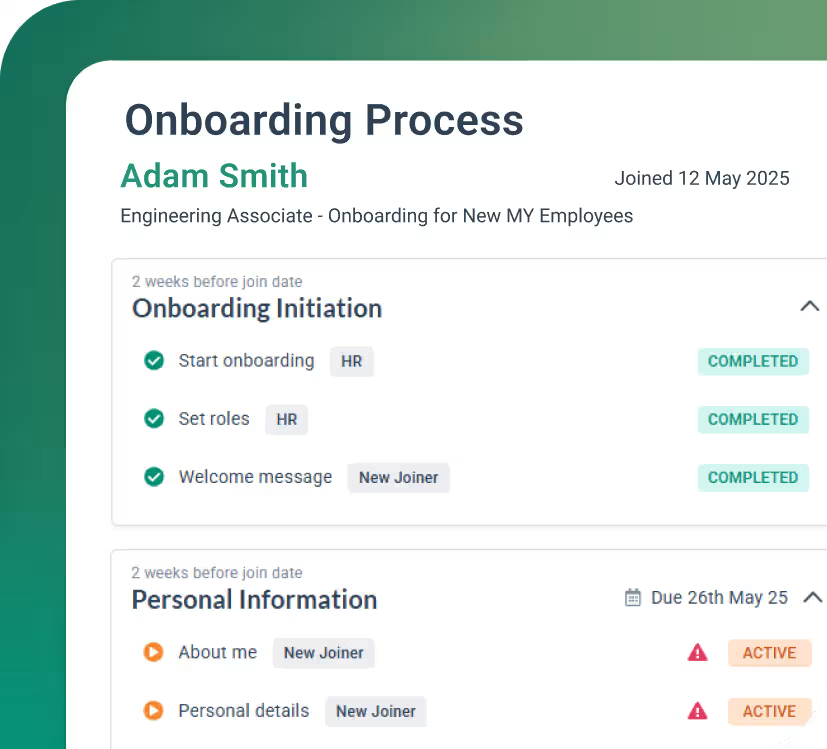
Set new hires up for success from day one
Turn onboarding into a clear, structured process that works for HR, managers, and new hires.
Conclusion
- The most practical thing Vanessa said in the entire episode wasn't about data or platforms or AI. It was this: if you're an HR leader working in F&B, retail, or any frontline-heavy industry, go work a shift. Serve tables. Work the floor. Understand what the job actually feels like before you try to design a process around it. "Go and work as a service crew yourself. Understand how hard it is, because then you can start speaking the language."
Everything HR.
One login
Cut the extra layers in your HR process. Keep what works, remove what doesn’t, and make everyday work easier for your team.
Want the full conversation on how HR can move from opinion to proof, from support to strategy, and from cost centre to value driver. Watch the full episode of withbrio.
To learn more about how brioHR can transform your HR processes, check out BrioHR’s website or request a demo.