Best Expense Management Systems in 2026

Key Takeaways
- brioHR: The best all-in-one pick for Malaysian and Southeast Asian teams. Expense claims, payroll compliance, and full HR in one connected platform. Ideal for growing SMEs and mid-market companies.
- Kakitangan: A strong choice for small Malaysian businesses that need affordable, compliance-ready payroll with basic claims handling and a fast rollout.
- HReasily: A solid fit for SMEs across Malaysia and Singapore that want cloud-based expense and payroll automation with dual statutory compliance.
- Workday HCM: Built for global enterprises with complex multi-entity expense workflows and advanced analytics. Best for teams with 10,000 or more employees.
Manual HR administration creates more problems than most teams expect.
Payroll errors, leave tracking mistakes, and disconnected expense claims all pile up into the same compliance risk, and they waste hours every single month.
Good news: local and regional expense management systems built for Malaysia and Southeast Asia already solve this. Whether you need expense management software for small business teams or a full enterprise platform, the right tool exists.
This article compares seven leading options, covering features, pricing, payroll capabilities, and best-fit use cases, so you can choose with confidence.
Best 7 Expense Management Systems in 2026: A Quick Look
| Tool | Best For | Standout Feature | Pricing |
|---|---|---|---|
| brioHR | All-in-One HR + Expense | Full MY/SG compliance + payroll integration | From RM3 per employee per month |
| Kakitangan | Cost-Focused Malaysian SMEs | Affordable statutory payroll + claims | Custom based on number of employees and modules chosen |
| HReasily | Automated HR Workflows | Mobile-first + automated expense processing | From RM4 per employee per month |
| altHR | Feature-Rich SME Management | Digital onboarding + expense workflows | From RM8 per employee per month |
| QuickHR | SMEs Standardizing HR Ops | Mature reporting + ISO 9001 certified | From RM7 per employee per month |
| HR2000 | Traditional Payroll-First Teams | Proven payroll + broad bank compatibility | Custom based on number of employees and modules chosen |
| Workday HCM | Global Enterprise Orgs | Advanced analytics + global payroll | Premium enterprise pricing |
If you want expense management that connects directly to payroll and HR without adding another disconnected tool, brioHR is worth a look.

brioHR: Best for All-in-One Expense Management and HR
brioHR is an all-in-one human resource management system (HRMS) built for growing companies in Malaysia and Southeast Asia. It brings expense claims, payroll, and people management into one platform, not scattered across five different tools.
HR and finance teams shouldn't waste hours reconciling expense data, chasing approvals, or manually uploading reimbursements to payroll. brioHR connects all of that automatically.
Key Features
brioHR covers the full employee lifecycle, from recruitment and onboarding to claims, payroll, and performance management. Here's where it stands out for expense management:
Expense Claims With Multi-Level Approval
Employees submit claims through mobile or desktop, attach receipts, and route approvals through custom multi-level workflows. Approved claims tie directly into payroll. No manual exports, no reconciliation at cut-off.
Payroll Connected to Expense, Leave, and Attendance
brioHR links claims, leave, and attendance directly to its payroll engine. The Employees' Provident Fund (EPF), Social Security Organisation (SOCSO), Employment Insurance System (EIS), Monthly Tax Deduction (PCB), Human Resources Development Fund (HRDF), and Lembaga Hasil Dalam Negeri (LHDN) workflows are handled natively, including EA Form and CP39 submissions. See brioHR payroll for a full breakdown.
Expense Analytics and Reporting
brioHR's reporting module gives HR and finance teams real-time visibility into claims spend by category, department, or employee. Custom report builders and people analytics are built in. See HR reporting software for more.
For more on brioHR's full module suite, visit digital employee file, time and attendance, leave and time off, performance management, and onboarding.
brioHR Pricing
| Plan | Details |
|---|---|
| Modular pricing | Per-employee pricing based on modules and company size, starting at RM3 per employee per month |
| Custom quote | Tailored based on headcount, workflows, and rollout needs |
Where brioHR Shines
- One platform for all of HR: Payroll, leave, claims, attendance, performance, and reporting in one connected system. No tool-stitching, no double data entry, no month-end reconciliation headaches.
- Malaysian and SEA compliance built in: EPF, SOCSO, EIS, and LHDN workflows handled natively. Statutory updates roll out automatically, so you're never caught off guard by regulatory changes.
- Sub-three-minute support response times: brioHR reports a 96% positive feedback rate with real human support. That matters most during payroll cut-off when delays cost money.
Where brioHR Falls Short
- Not a short-term fix: brioHR is built for teams committing to a proper HR and payroll system. If you need something temporary or single-purpose, it's more platform than you need.
- Sized for teams with real HR complexity: Very small teams (under 5 people) may not use enough of the platform to justify the full setup investment.
brioHR Customer Reviews
brioHR holds 4.7 stars from verified G2 reviews. Users highlight the platform's intuitive experience and responsive support. Capterra reviewers mention easy implementation, strong analytics, and reliable day-to-day usability.


Who brioHR Is Best For
- Growing SMEs: Teams replacing spreadsheets or disconnected payroll and claims tools.
- Mid-sized companies: Businesses that need compliance, claims automation, and stronger reporting in one place.
- Regional teams: Malaysia and Southeast Asia companies that want one unified HR and expense platform.
Kakitangan: Best for Cost-Focused Malaysian Micro-SMEs
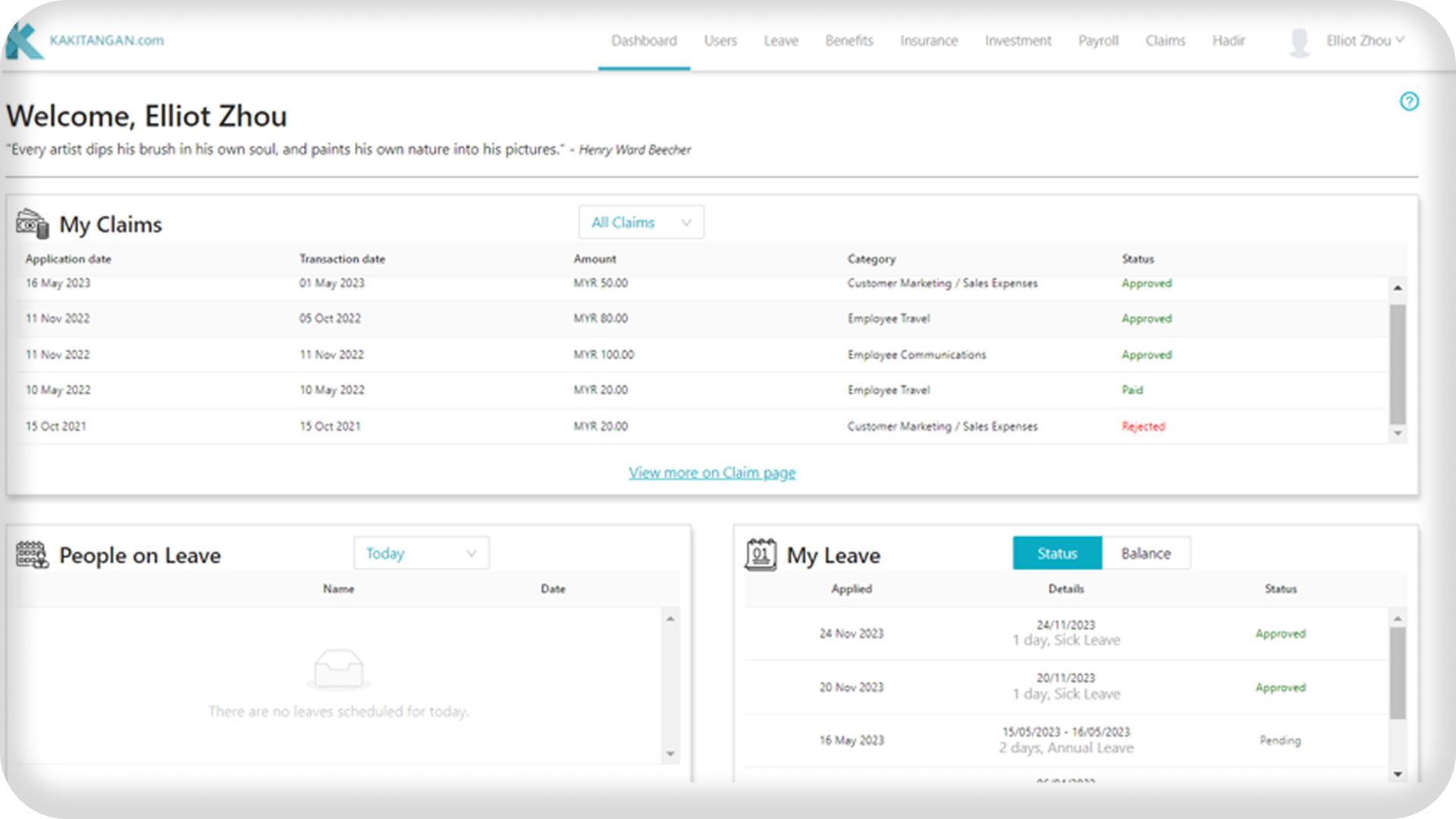
Kakitangan is a Malaysia-focused payroll and HR platform built for small businesses. It is one of the most widely used expense management platforms among Malaysian SMEs moving off spreadsheets: affordable, locally compliant, and fast to deploy.
Key Features
- Payroll processing: Salary calculations, payslips, and full statutory submissions including EPF, SOCSO, EIS, PCB, and LHDN e-filing.
- Expense claims: Receipt photo upload, multi-level claim approval, mileage tracking, and reimbursement via payroll.
- Attendance: Mobile GPS clock-in, geo-fencing, and overtime tracking for field, retail, and shift-based teams.
- HR advisory support: Access to HR guidance alongside the software, useful for SMEs without a dedicated HR team.
Pricing
| Plan | Details |
|---|---|
| Payroll pricing | Based on number of staff and module selected |
Where Kakitangan Shines
- Affordable for Malaysian SMEs: One of the lower-cost options in the market with full Malaysian statutory payroll coverage out of the box.
- Claims linked to payroll: Expense claims connect directly to payroll calculations, simplifying reimbursement for small teams.
- Fast to roll out: Implementation typically takes around one month, ideal for teams moving quickly off spreadsheets.
Where Kakitangan Falls Short
- No recruitment, onboarding, or performance management: Applicant tracking system (ATS), digital onboarding, Objectives and Key Results (OKRs), and 360 feedback are all absent, which limits usefulness as teams grow.
- Limited scalability: No multi-entity support, single sign-on (SSO), or application programming interface (API) access, which is a real constraint once headcount grows past 100.
- Support inconsistency: Some users report slower response times during critical payroll moments.
Customer Reviews
Reviews highlight affordability and helpful guidance for SMEs. Some users flag feature limitations as the business grows.
"Affordable and easy to use for small teams."
Who Kakitangan Is Best For
- Small businesses: Teams with simple payroll and claims needs that don't require advanced HR modules.
- Cost-conscious companies: Businesses prioritizing budget over feature breadth or scalability.
HReasily: Best for Automated HR Workflows
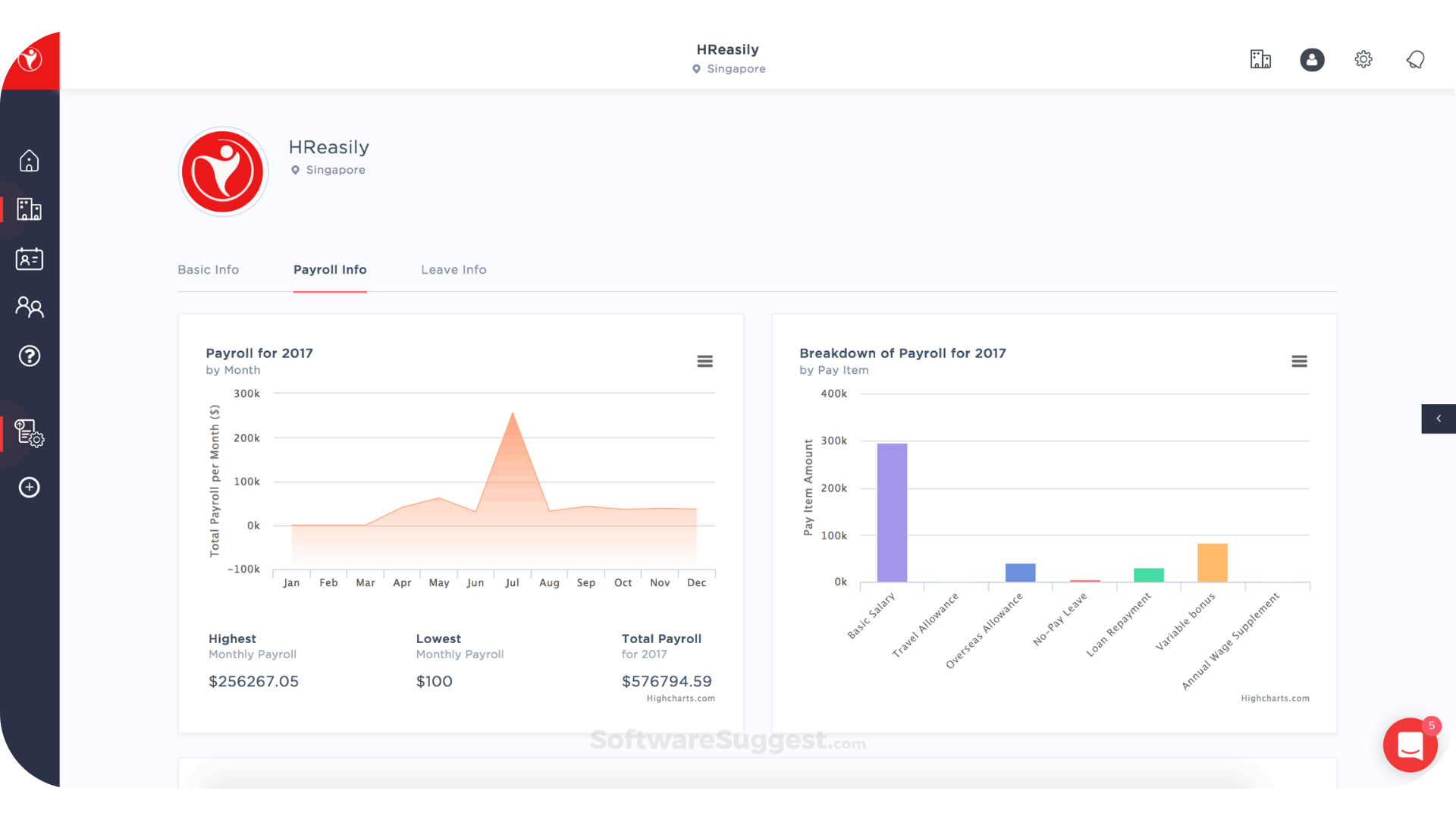
HReasily is a cloud-based HR and payroll platform serving SMEs across Malaysia and Singapore. It covers automated payroll, claims management, and time attendance, with a mobile-first interface accessible anywhere.
Key Features
- Automated payroll: Full Malaysian and Singapore statutory compliance including EPF, SOCSO, Central Provident Fund (CPF), and Skills Development Levy (SDL). Payroll runs are automated and audit-ready.
- Expense claims processing: Mobile receipt upload, claim categories, multi-level approval workflows, and reimbursement via payroll.
- Leave and attendance: Mobile app access for leave applications, GPS attendance tracking, and shift scheduling.
- HR reporting and analytics: Compliance reporting and basic analytics built into the platform.
Pricing
| Plan | Details |
|---|---|
| Pricing | From RM4 per employee per month |
Where HReasily Shines
- Dual Malaysia and Singapore compliance: Supports MY and SG statutory requirements natively, which is useful for cross-border SME teams in both markets.
- Mobile accessibility: Employees and managers handle expenses, leave, and payroll from any device, anytime.
- Regulatory compliance built in: Keeps payroll automatically aligned with Malaysian and Singaporean statutory requirements.
Where HReasily Falls Short
- Limited advanced HR modules: No recruitment (ATS), performance management, or learning and development.
- Basic expense analytics: Limited reporting depth for teams needing detailed spend visibility.
Customer Reviews
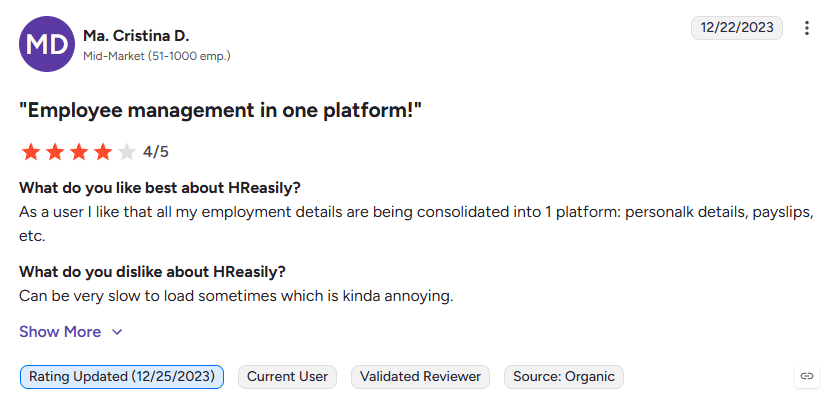
Users appreciate the mobile-friendly interface and payroll automation. Some note the platform feels lightweight for larger teams.
Who HReasily Is Best For
- SMEs in Malaysia or Singapore: Teams that want payroll and expense automation across both markets.
- Mobile-first teams: Organizations that prioritize on-the-go access to HR and claims tools.
altHR: Best for Feature-Rich SME Management
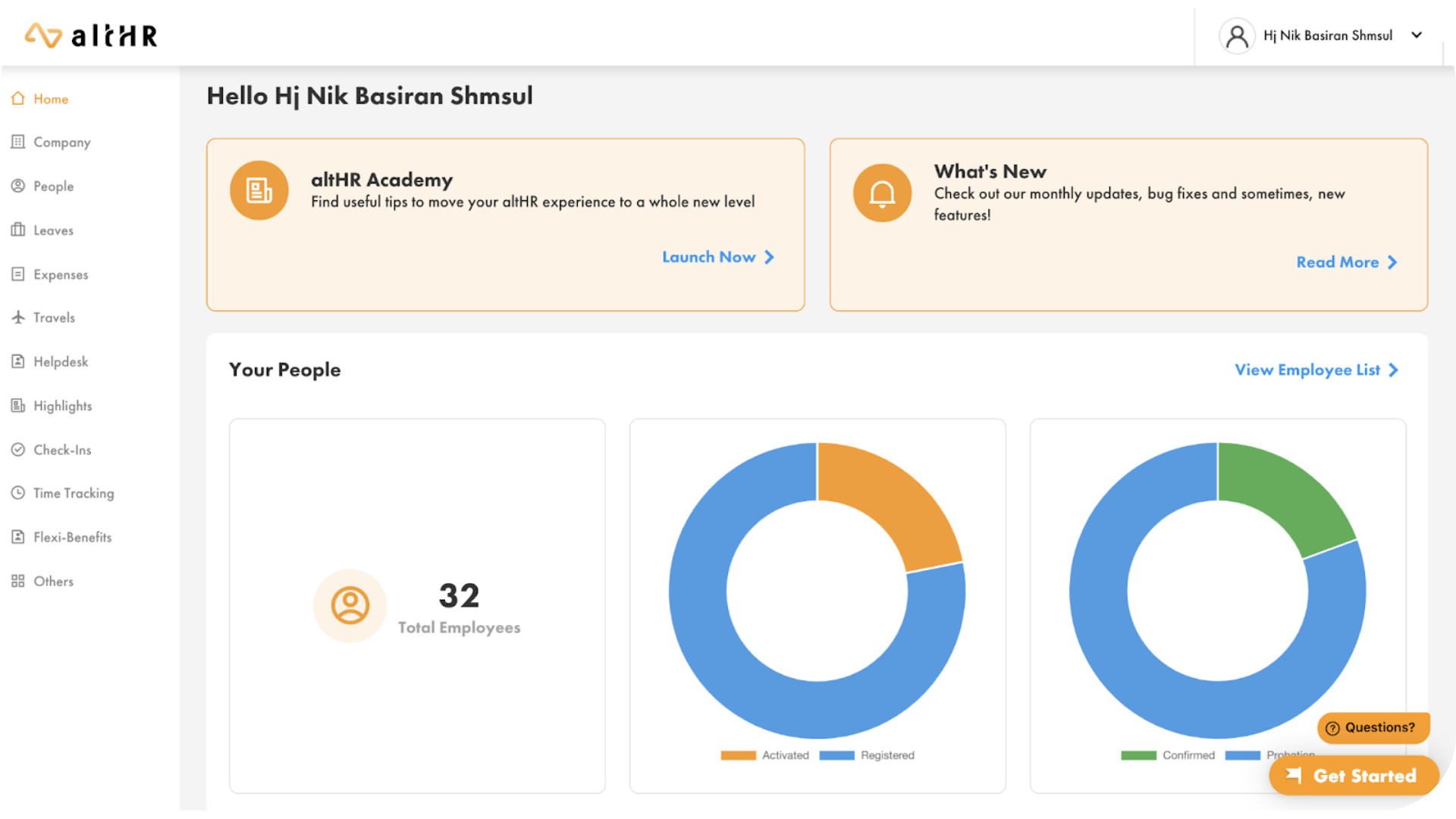
altHR is a Malaysian HRMS platform built for SMEs and mid-market companies that want more than payroll. It combines expense claims, digital onboarding, and performance management in one system. This is uncommon at its price tier.
Key Features
- Expense claims: Mobile submission, multi-level approval workflows, claim categories, and reimbursement integrated with payroll.
- Digital onboarding: Pre-boarding, checklists, task assignments for managers, and welcome portals for new hires.
- Performance management: Goal setting, OKRs, key performance indicator (KPI) tracking, 360-degree feedback, and performance dashboards.
- Leave and attendance: Full leave management with multi-level approval flows, GPS attendance tracking, and overtime calculation.
altHR Pricing
| Plan | Details |
|---|---|
| Starting Price | From RM8 per employee per month |
Where altHR Shines
- Broader feature set for SMEs: Includes onboarding and performance management that most payroll-focused tools in this tier don't offer.
- Advanced role-based permissions: Suitable for teams that need granular access controls across departments or entity structures.
- Multi-language support: Useful for diverse or regional teams across multiple locations.
Where altHR Falls Short
- No recruitment or ATS: Job posting, resume parsing, and candidate pipeline management are missing.
- Partial multi-entity support: Cross-company setups have limitations at scale.
- Support experience varies: Some users report inconsistency in support responsiveness.
Find an applicant tracking system in Malaysia for your team.
Customer Reviews
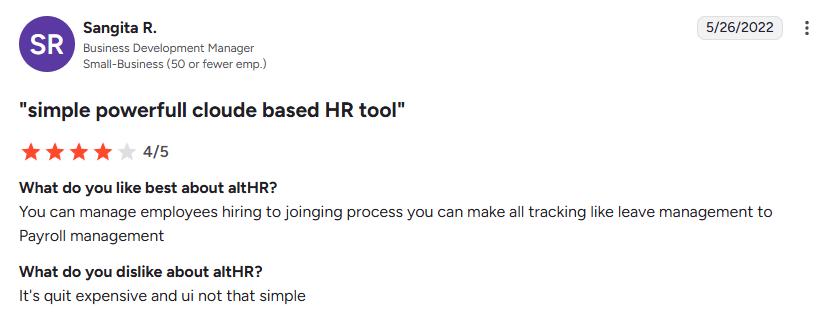
Users highlight the intuitive interface, smooth claims and leave processing, and feature depth for an SME tool. Some mention occasional app glitches.
Who altHR Is Best For
- SMEs wanting more HR depth: Teams that need onboarding and performance tools beyond basic payroll and claims.
- Mid-market Malaysian companies: Businesses scaling up their HR stack without going enterprise.
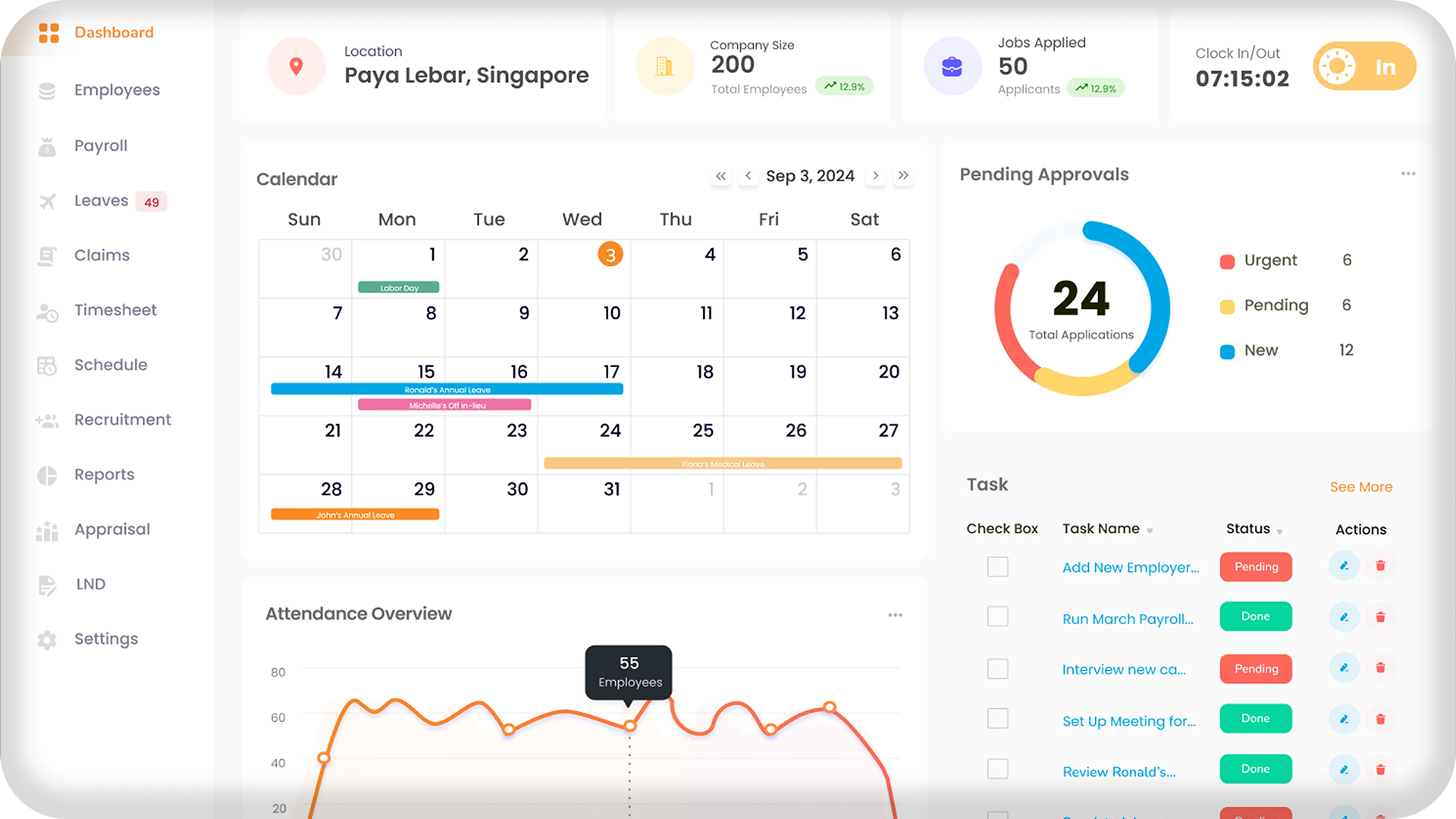
QuickHR: Best for SMEs Standardizing HR Operations
QuickHR is a Singapore-first HR platform with broad module coverage across leave, claims, attendance, document management, and contract management. ISO 9001:2015 certification adds credibility for teams with stricter procurement requirements.
Key Features
- Expense claims: Multi-level approval, mileage tracking, claim categories, and expense analytics included.
- Singapore-native payroll: Full CPF, SDL, Income Tax Return (IR8A), and IR21 support with Productivity Solutions Grant (PSG) eligibility for eligible Singapore SMEs.
- Attendance and shift management: Mobile GPS clock-ins, geo-fencing, rotating shifts, and automatic overtime calculations.
- Mature reporting: Custom report builder and people analytics at a mid-market price point.
QuickHR Pricing
| Plan | Details |
|---|---|
| Modular pricing | Custom quote based on company size and modules selected. From RM7 per employee per month |
Where QuickHR Shines
- Strong daily HR coverage: Leave, claims, attendance, document management, e-signatures, and contract management with configurable multi-level approvals.
- Advanced shift management: Rotating shifts and automatic overtime calculations make it ideal for retail, hospitality, and field teams.
- ISO 9001:2015 certified: Adds audit-readiness for organizations with stricter procurement requirements.
Where QuickHR Falls Short
- Singapore-first, Malaysia through a partner: Malaysian statutory compliance (EPF, SOCSO, EA Form, LHDN) is partially partner-delivered, meaning slower turnaround when local rules change.
- No recruitment, onboarding, or performance management: Missing key modules that growing teams typically need.
Customer Reviews
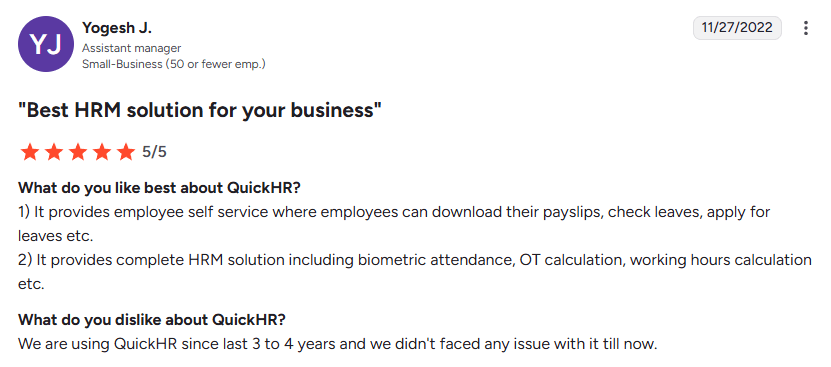
G2 reviewers highlight reduced HR workload through employee self-service and fewer overtime errors. Support response times get consistent positive mentions.
Who QuickHR Is Best For
- Singapore SMEs: Teams standardizing HR processes with strong native Singapore payroll needs.
- Process-led buyers: Companies that prefer structure, audit-readiness, and consistent approval workflows.

HR2000: Best for Stable, Proven Malaysian Payroll
HR2000 is a long-standing Malaysian payroll and HR system focused on core HR administration and employee self-service (ESS). It is widely used by companies that prefer familiar, stable workflows for payroll, leave, and claims.
Its strength is proven payroll reliability and broad bank compatibility, with support for 50+ bank formats for salary processing. EPF, SOCSO, PCB, and EIS are all handled, along with EA Form and payslip generation.
The limitation is that the platform hasn't evolved much beyond traditional HR systems. Expect an older interface, on-premise infrastructure, and missing modules like recruitment, onboarding, and performance management. HR2000 suits companies with basic payroll needs that prefer an established local vendor over a modern cloud platform.

Workday HCM: Best for Complex Global Enterprise Systems
Workday HCM is a full enterprise platform built for large global organizations. Its expense management capabilities include corporate card integration, multi-currency expense workflows, per-diem policies, and advanced spend analytics.
Workday covers payroll, recruitment, performance, learning and development, and workforce planning at enterprise scale. The trade-off: pricing sits in the $$$$ tier, implementation typically runs 12 to 24 months, and Malaysian statutory workflows (LHDN, EA Form, HRDF) are configured rather than natively built.
For global enterprises with 10,000 or more employees and dedicated human resource information system (HRIS) and IT teams, it is unmatched. For most Malaysian businesses, it is overbuilt and overpriced.
Make performance management effortless
Streamline goals, reviews, and feedback in one flow—so managers can focus on real performance conversations.

How to Choose the Best Expense Management System
Not every expense management platform solves the same problem. Here's what to evaluate before committing.
1. Claims-to-Payroll Integration
The biggest operational headache in expense management isn't submission. It's reimbursement.
If your claims system doesn't connect directly to payroll, your finance team manually exports, reconciles, and re-enters data every month. That's where errors compound.
Look for platforms where approved claims automatically feed into the next payroll cycle. brioHR does this natively: claims, leave, and attendance flow into one payroll engine with nothing to reconcile manually.
For related context, see employee onboarding in Singapore.
Pro Tip: Ask vendors whether claims data integrates with payroll automatically or requires a manual export step. The answer separates good tools from great ones.
See How brioHR Handles Claims and Payroll
2. Local Statutory Compliance
In Malaysia, every expense reimbursement passing through payroll must align with EPF, SOCSO, PCB, and LHDN requirements. A platform that gets this wrong creates compliance risk, not just admin headaches.
Choose a system where statutory updates roll out automatically, not ones you configure manually every time contribution rates change.
brioHR's payroll module handles this automatically for both Malaysian and Singaporean requirements. See also: CPF updates and compliance and brioHR security standards.
3. Approval Workflow Flexibility
A rigid, single-level approval process breaks down fast in a real company. A travel claim might need a manager plus finance sign-off; a stationery receipt needs just one.
Look for multi-level, configurable approval workflows, and check that approvals work on mobile.
Did You Know? According to Levvel Research, the average cost to process a single paper-based expense report is $26.63. Automated expense management cuts that cost significantly for most organizations. (Levvel Research, Payables Insight Report)
For more on building your business case, read how to justify the cost of HR software. Also helpful: 14 types of leave every HR professional should know and applicant tracking and recruitment in Singapore.
Manage Expenses, Payroll, and HR in One Platform With brioHR
If you want expense management that connects to the rest of your HR and payroll stack, without tool-stitching or manual reconciliation, brioHR is the right starting point for most Malaysian and Southeast Asian teams.
It's built for growing companies that need one system for claims automation, statutory payroll compliance, attendance tracking, and people management. Unlike standalone best expense management software options, everything is connected from day one.
If you're still evaluating options, explore brioHR services or read how other teams have made the switch via brioHR customer stories.
Ready to see it in action?