A Guide to Malaysia’s Annual Tax Forms (Form EA and Form E)

Key Takeaways
- Form EA is a mandatory statement summarising an employee’s annual earnings and must be issued to all eligible employees.
- Employers must include all types of remuneration such as salary, bonuses, allowances, and benefits when preparing Form EA.
- Form E is an annual declaration submitted to LHDN detailing employee information, total remuneration, and tax deductions.
- All eligible employers are required to submit Form E online using LHDN’s system or approved payroll software.
- Failure to comply with Form EA and Form E requirements or deadlines may result in significant penalties.
It is said that nothing is certain in life, except for death and taxes. As of the time of publishing this article, it’s that time of year again that everyone is bracing for: tax season.
As an employer, you have two very important tax-related obligations at the beginning of every year:
You need to prepare Form EA for every employee.
You will also need to file Form E with the Inland Revenue Board, or Lembaga Hasil Dalam Negeri (LHDN).
Here, we break down each form so you can understand it better and file it appropriately.
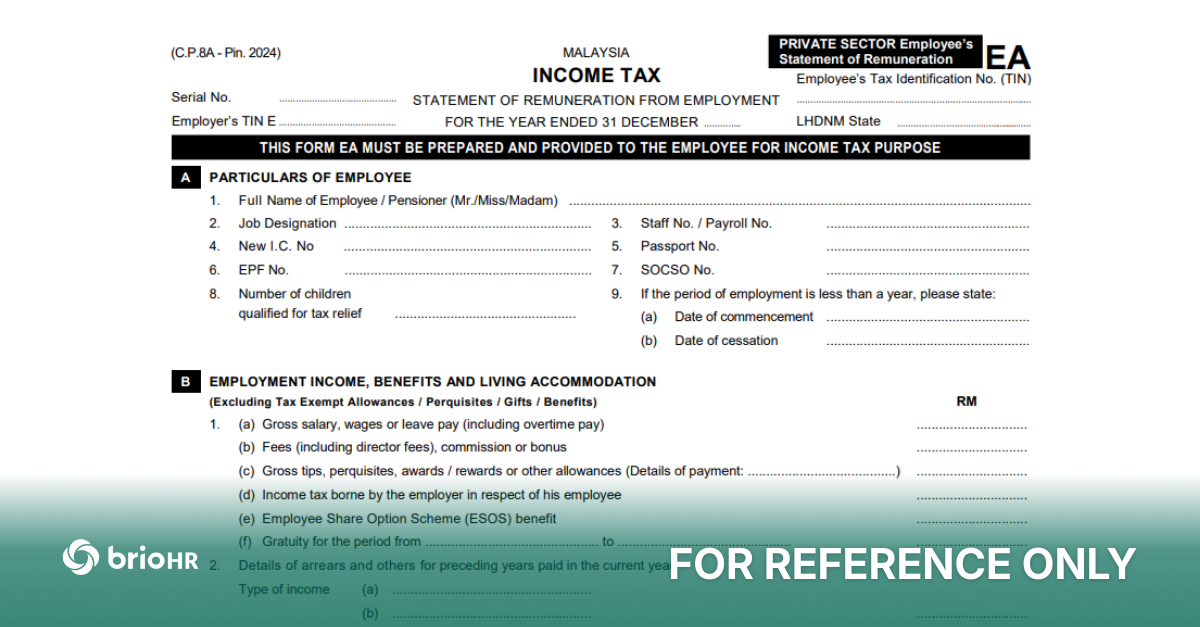
What is Form EA?
Officially known as the “Statement of Remuneration from Employment”, put simply Form EA is a summary of the employee’s earnings from the employer for the year.
The purpose of Form EA is to enable employees to file their own taxes properly and declare their earnings to LHDN. That way, it can be determined which tax bracket they fall under.
It is mandatory for the employer to prepare Form EA for every employee, regardless of full-time, part-time, or fixed term status. As long as the employee has worked for more than seven days, and has received payment for their work, Form EA must be issued to the employee.
The following categories of employment earnings need to be included in Form EA:
- Gross salary
- Overtime pay
- Commission
- Bonus or other gratuities
- Allowances or perquisites such as travel allowance and meal allowance
- Benefits in kind such as health insurance or company car and driver
- Value of Living Accommodation (VOLA)
- Contributions to private pension by employer
- Compensation for loss of employment
The deadline for providing Form EA for the year ending 31 December 2025 is 28 February 2026. You can view a sample of Form EA here.
“What gets measured gets managed.”
| Process | Responsible Party | Deadline |
|---|---|---|
| EA Form Issuance | Employer → Employee | 28 February 2026 |
| Employer Form E + CP8D Submission | Employer → LHDN | 31 March 2026 |
| Employee e-Filing (Form BE) | Individual | 30 April 2026 (manual) 15 May 2026 (e-Filing) |
| Sole Proprietor / Partnership Filing | Business Owner | 30 June 2026 |
What is Form E?
Form E is a declaration made by the employer to LHDN on the number of employees, total remuneration paid to them, as well as the total amount of tax deductions for the year.
It is compulsory for the following employers to submit Form E:
- Companies registered with the Companies Commission of Malaysia such as Sdn Bhd, Berhad, or LLP, with or without employees
- Sole proprietors with employees
- Partnerships with employees
- Sole proprietors without employees
- Partnerships without employees

Reduce the small frictions that slow your team down.
From approvals to payroll to performance tracking, keep everything aligned with how people actually work.

FAQs
What is the difference between Form EA and Form E in Malaysia?
Form EA is a statement of an employee’s annual remuneration issued by the employer, while Form E is the employer’s annual declaration to LHDN on employee details, total remuneration paid, and tax deductions for the year.
Is it mandatory for employers to issue Form EA?
Yes. Employers must prepare and issue Form EA to every employee who has worked for more than seven days and received payment.
What information should be included in Form EA?
Form EA includes salary, bonuses, allowances, benefits in kind, Value of Living Accommodation, employer contributions, and compensation.
Who needs to submit Form E to LHDN?
Companies, sole proprietors with employees, and partnerships with employees must submit Form E. Filing is recommended even if not mandatory.
What are the deadlines for Form EA and Form E for the 2026 filing cycle?
Form EA must be issued by 28 February 2026, while Form E must be submitted by 31 March 2026.
Everything HR.
One login
From payroll to onboarding, brioHR gives you everything you need in one place. Built for busy teams. Backed by people who care.

Conclusion
- Understanding Form EA and Form E is essential for employers to stay compliant with Malaysia’s tax regulations.
- Accurate and timely preparation of these forms helps employees file their taxes correctly without issues.
- Keeping track of key deadlines ensures businesses avoid unnecessary penalties and disruptions.
- Automating payroll and tax processes can greatly reduce administrative workload and human error.
- With the right systems in place, businesses can focus more on growth while ensuring compliance.
To learn more about how brioHR can transform your HR processes, check out BrioHR’s website or request a demo.