Best Healthcare HR Software for Healthcare Teams in 2026
Key Takeaways
- brioHR is the strongest all-in-one pick for clinic groups, nursing homes, and mid-sized hospitals in Malaysia and Singapore that need rotating-shift attendance, statutory payroll, and compliance records in one system
- QuickHR suits Singapore healthcare SMEs that want audit-ready HR operations, with ISO 9001:2015 certification and up to 50% Productivity Solutions Grant (PSG) funding
- Swingvy works well for mobile-first clinic, home-care, and community nursing teams where staff clock in from the field rather than a desk
- Workday HCM is the realistic choice for hospital networks above roughly 10,000 employees, while Employment Hero, altHR, and HReasily each fit narrower budgets and footprints
- Healthcare turnover runs far ahead of most industries: the 2026 NSI National Health Care Retention & RN Staffing Report puts hospital turnover at 18.5% and registered nurse turnover at 17.6%, which means your HR system is handling new joiners and leavers almost constantly
Below, we compare features, pricing, honest trade-offs, and who each platform genuinely fits.
Your charge nurse just messaged the ward group at 6am because two people swapped nights without telling anyone, the timesheet no longer matches the roster, and payroll closes Friday. Meanwhile a dental assistant's practising certificate expired three weeks ago and nobody noticed, because it lives in a folder on somebody's desktop.
That is the daily reality behind the search for the best healthcare HR software. Clinical rosters change hourly, statutory contributions cannot be late, and credential records have to survive an audit.
This guide compares seven platforms available to healthcare employers in Malaysia and Singapore, with pricing, feature depth, real trade-offs, and the criteria we used to rank them.
Best 7 Healthcare HR Software in 2026: A Quick Look
| Tool | Best For | Standout Feature | Price Starting Point |
|---|---|---|---|
| brioHR | All-in-one healthcare HR and payroll (MY/SG) | Rotating-shift attendance with facial recognition and biometric devices, wired into payroll | From RM3 per employee per month |
| QuickHR | Singapore healthcare SMEs needing audit-ready HR | ISO 9001:2015 certified, PSG-eligible, native CPF/SDL/IR8A | From S$5 per employee per month |
| Swingvy | Mobile-first clinic and home-care teams | Geofenced GPS clock-in with a high-adoption mobile app | From RM8.50 per user per month (plus payroll module) |
| Workday HCM | Large hospital networks and multi-entity groups | Workforce planning, succession, and predictive analytics at scale | Custom enterprise quote (commonly six figures annually) |
| Employment Hero | Employers prioritising engagement and retention | Pulse surveys and recognition alongside core HR | From USD $10 per employee per month, minimum monthly spend |
| altHR | Malaysian clinic and dental groups | OKRs, KPI tracking, and 360 feedback at an SME price | From RM8 per employee per month (modular) |
| HReasily | Small practices operating in both MY and SG | Dual Malaysian and Singaporean statutory payroll | From RM4 per employee per month |
Prices shift, modules get bundled differently, and healthcare organisations rarely buy the base plan. Treat the figures above as entry points and get a quote against your actual headcount and shift patterns.
See what one connected system looks like for a clinical team. Request a demo and we will walk through rosters, payroll, and compliance records using your own staffing structure.
brioHR: Best for All-in-One Healthcare HR and Payroll in Malaysia and Singapore
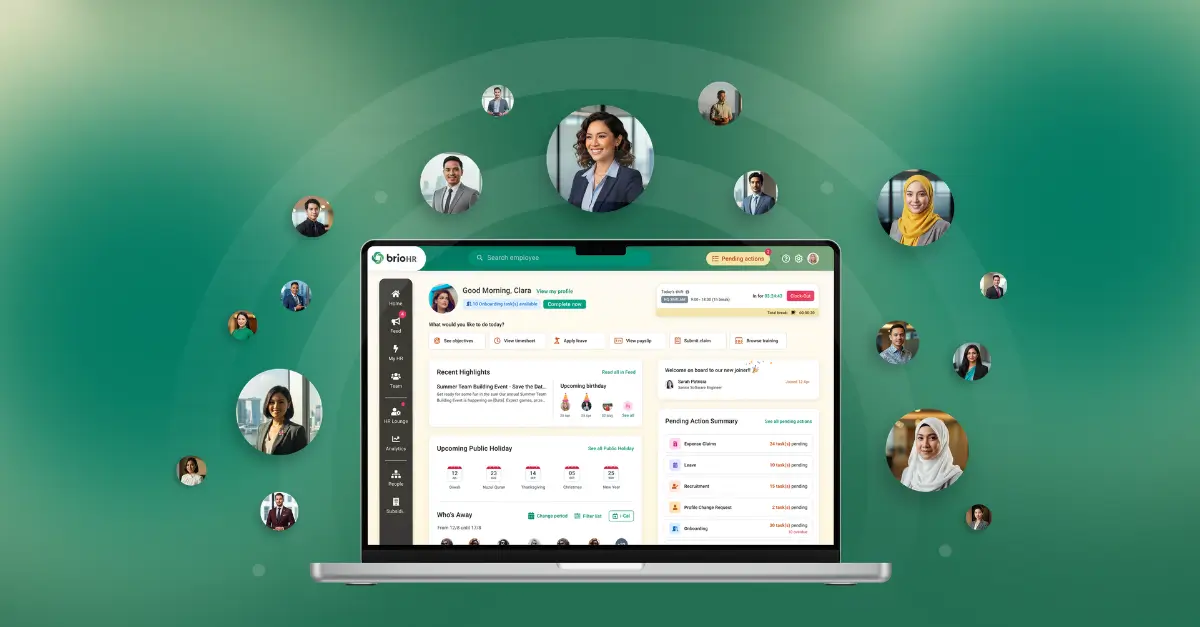
brioHR runs the full employee lifecycle for healthcare employers on one platform: hiring, onboarding, rotating-shift attendance, leave, claims, payroll, performance, and reporting. More than 1,000 organisations across 50 countries use it, including WWF Malaysia, Boustead Group, and H&M.
For clinic groups, nursing homes, and mid-sized hospitals, the draw is that clinical attendance data and statutory payroll sit in the same system rather than two subscriptions that need reconciling every month.
brioHR Key Features
Three capabilities matter most to healthcare operations teams, so we have gone deeper on those rather than listing every module.
Rotating-Shift Time and Attendance With Biometric and Facial Recognition
Healthcare rosters break most attendance tools. Staff rotate across days, nights, and weekends, cover at short notice, and split hours across two sites in the same week.
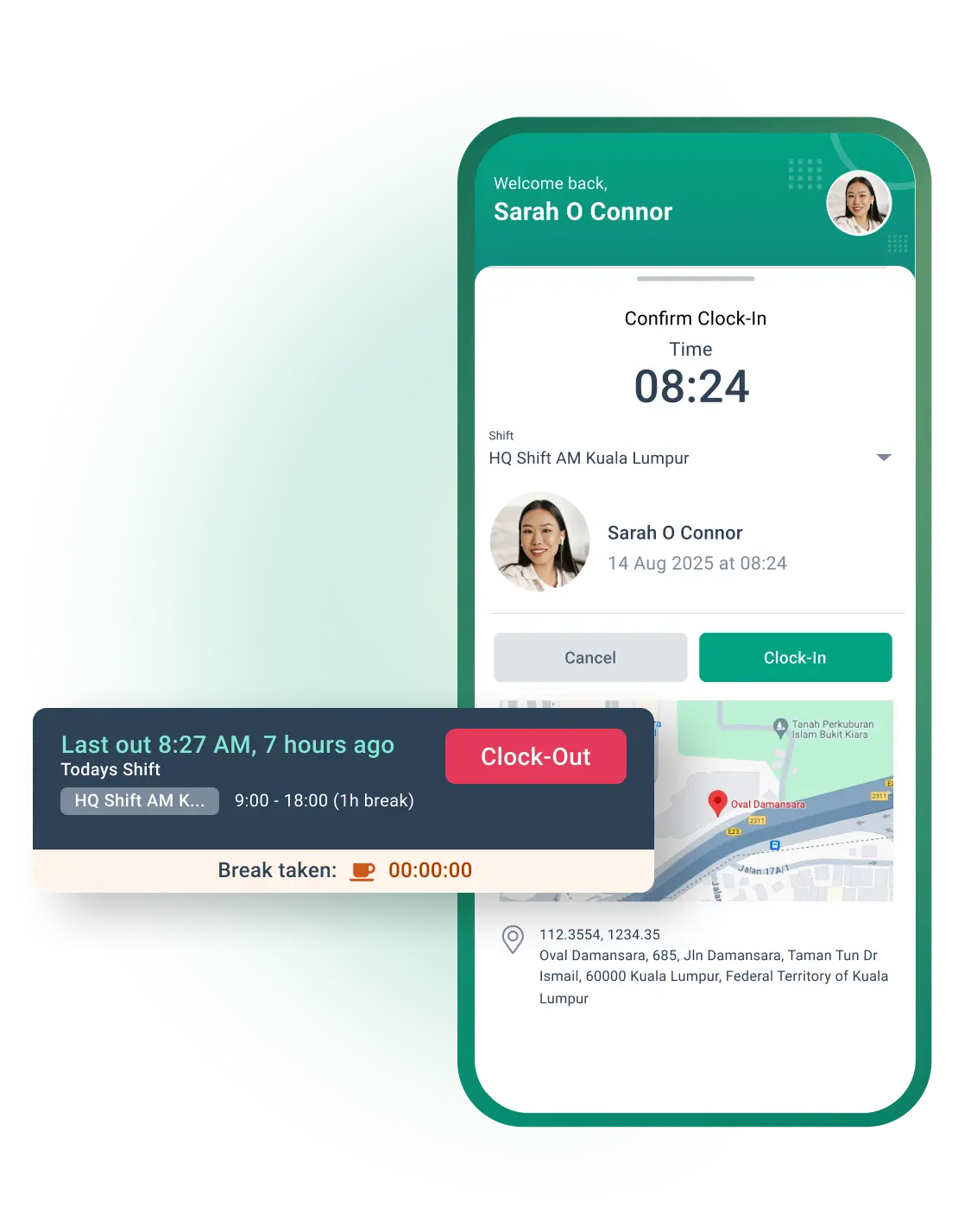
brioHR's time and attendance module handles rotating shift patterns, shift scheduling, overtime auto-calculation, break tracking, and late or absent alerts. Clock-in options cover mobile GPS with geofencing for community and home-care staff, facial recognition for ward and reception entry points, and integration with biometric or RFID hardware already installed at a site.
Among the local platforms in this comparison, brioHR is the only one supporting both facial recognition and biometric device integration natively rather than through a third-party bridge. Approved hours then flow into payroll without a manual export, which is where most shift-heavy employers lose their Friday afternoons. If you want the detail on how that connection works, our guide to payroll system integration covers the mechanics, and timesheets shows the manual-entry and approval flow for salaried clinical staff.
Statutory Payroll for Malaysia and Singapore in One Platform
Payroll for a healthcare employer is rarely one clean monthly run. You have salaried clinicians, hourly support staff, locums, night differentials, and claims that all land at different times.
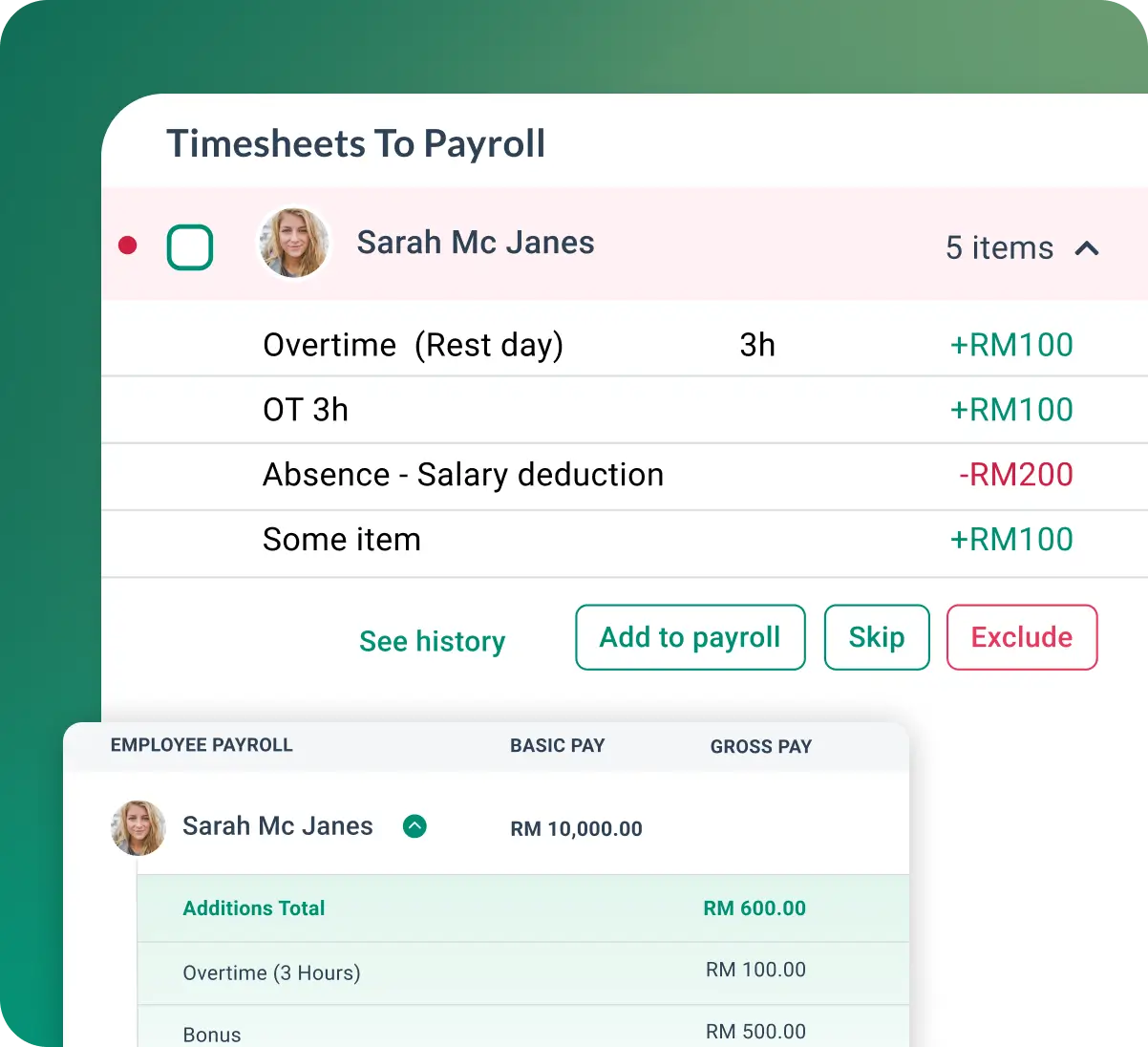
brioHR's payroll engine supports multiple pay frequencies and cycles, and calculates EPF, SOCSO, EIS, PCB, and HRD Corp for Malaysia alongside CPF, SDL, IR8A, and IR21 for Singapore. Statutory forms including EA, CP39, Form E, and CP8D are generated in-platform, and statutory rate changes roll out automatically rather than waiting on an upgrade cycle.
Leave, claims, and attendance feed the run directly, so a nurse who worked two overtime nights and submitted a mileage claim for a home visit appears correctly on one payslip. Groups running several registered entities can process them under one login, which matters for practices that incorporate each clinic separately. Our annual tax forms guide walks through the year-end filing side.
Credential Records, Reporting, and Workforce Analytics
Healthcare carries a documentation load most industries do not: practising certificates, vaccination records, police checks, indemnity cover, training and CPD completions, and disciplinary files that all need to be retrievable years later.
brioHR's digital employee file stores those documents against each person with role-based permissions, contract management, and an audit trail of who viewed or changed what. Training records sit alongside them, including HRD Corp and SBL-Khas tracking for Malaysian employers claiming levy.
On the reporting side, brioHR is a capable HR reporting software provider for healthcare: custom report builders, headcount dashboards, attrition analytics by department or grade, and scheduled report emails that land in a matron's or practice manager's inbox without anyone running an export. Combined with pulse surveys and performance management, you can see which units are losing people and act before the roster gaps appear. For a wider look at reporting options, see our roundup of HR reporting tools for enterprise teams.
brioHR Pricing
| Plan | Details |
|---|---|
| Modular | Per-employee pricing from RM3 per employee per month, based on which modules you activate |
| Custom quote | Priced on headcount, number of entities, shift complexity, and rollout support |
| Managed payroll | Available as an add-on service through brioHR's payroll outsourcing team |
Singapore businesses should check PSG eligibility before signing: brioHR is a PSG-approved HRMS, which changes the net cost considerably for smaller practices.
Where brioHR Shines
- Support that answers during payroll week: average first response is under three minutes with a 96% positive feedback rate. For a nursing home closing payroll on a Thursday night, that difference is operational, not cosmetic
- Security posture suited to health data: ISO 27001 certified with 99.9% uptime, role-based permissions, and full audit logging. Our security page sets out the controls, and this guide to securing HR data covers what to ask any vendor
- Holds together from 30 staff to 3,000: approvals, multi-entity workflows, and reporting do not degrade as a two-clinic practice becomes a twelve-site group. Typical implementation runs around two months
Where brioHR Falls Short
- No clinical or practice-management integration out of the box: brioHR does not connect to electronic medical records, patient scheduling, or billing systems. If your requirement is one platform spanning both patients and staff, that gap is real and you will need separate systems
- Thin on formal learning delivery: training records and HRD Corp tracking are covered, but there is no e-learning module, course catalogue, or skills matrix. Hospitals running structured CPD curricula in-house will keep a separate LMS
- No Zapier or open integration marketplace: API access exists, but teams used to wiring tools together with no-code connectors will find fewer off-the-shelf options than with a global platform
brioHR Customer Reviews
brioHR holds 4.7 out of 5 from 31 verified G2 reviews and 4.9 out of 5 from 57 Capterra reviews.

Who brioHR Is Best For
- Multi-site clinic and dental groups: practices running several locations and entities that need one roster, one payroll, and one set of staff records
- Nursing homes and aged-care operators: employers with heavy rotating shifts, high part-time headcount, and strict documentation retention requirements
- Mid-sized hospitals and specialist centres: organisations between roughly 100 and 1,000 staff that need enterprise-grade compliance without an enterprise implementation timeline
- Regional healthcare groups across MY and SG: teams that want both countries' statutory requirements handled natively in the same system
Further reading: Best HR Software in Malaysia for SMEs & Enterprises · Best HR Software in Singapore for SMEs & Enterprises · Client success stories
Bring rosters, pay, and credential records into one place. Book a demo with a consultant who has set this up for healthcare operators before.
Handle Singapore payroll rules with confidence
CPF, statutory contributions, and voluntary deductions managed in one place.

QuickHR: Best for Singapore Healthcare SMEs Needing Audit-Ready HR
QuickHR is a Singapore-first HR platform with broader module coverage than most payroll-only tools. It covers leave, claims, attendance, timesheets, document management, contract management, and e-signature, which maps closely to what a clinic or nursing home needs on file.
Its ISO 9001:2015 certification carries weight with procurement and audit teams, and it is PSG-eligible for Singapore SMEs.

QuickHR Key Features
Shift and Overtime Handling
Mobile GPS clock-ins, geofencing, rotating shift support, and automatic overtime calculation cover the rostering basics for ward, reception, and allied health staff. Timesheets support manual entry with multi-level approval, useful where a unit manager signs off before a practice administrator does.
Documentation and Contract Management
Employee documents, e-signature, contract management, and job grade or band management are all included. For practices that need signed variations, renewals, and licence copies retrievable on request, this is more coverage than most tools at the same price.
QuickHR Pricing
| Plan | Details |
|---|---|
| Modular | From S$5 per employee per month, priced on company size and modules selected |
| Grant funding | Up to 50% PSG funding for eligible Singapore businesses |
Where QuickHR Shines
- Native Singapore statutory payroll: full CPF, SDL, IR8A, and IR21 workflows, with multi-currency payroll for groups employing across borders
- Reporting depth at a mid-market price: a custom report builder, people analytics, and headcount dashboards are included rather than reserved for an enterprise tier
- Quality certification and quick setup: ISO 9001:2015 certified with implementation typically around three months
Where QuickHR Falls Short
- Malaysian payroll is delivered through a partner: EPF, SOCSO, EIS, PCB, and HRD Corp are partner-based rather than fully native, and HRD Corp or SBL-Khas training levy tracking is absent
- No recruitment, onboarding, or performance modules: applicant tracking, structured onboarding flows, review cycles, OKRs, and 360 feedback are all missing, which is limiting for employers hiring continuously against turnover
- Light engagement tooling: no pulse surveys, recognition, or internal comms features
QuickHR Customer Reviews

Who QuickHR Is Best For
Singapore clinics, dental practices, and nursing homes that want structured, auditable HR administration and will handle recruitment and performance elsewhere. Also a sensible pick for SMEs wanting to stretch budget with PSG funding, as covered in our guide to choosing HR software in Singapore.
Swingvy: Best for Mobile-First Clinic and Home-Care Teams
Swingvy combines core HR administration and payroll in a modern, mobile-led interface. It is commonly chosen by SMEs moving off spreadsheets that want something staff will actually open, rated 4.0 out of 5 on usability in independent comparisons.
For community nursing, home-care visits, and multi-site clinic cover, the mobile app is the practical selling point.

Swingvy Key Features
Geofenced Mobile Clock-In and Shift Scheduling
iOS and Android apps handle leave requests, claims, and clock-ins with GPS and geofencing, plus shift scheduling and overtime tracking. Staff visiting patients at home can clock in at the door rather than back at base, and location data is attached to the record.
Dual-Country Statutory Payroll
Swingvy runs native Malaysian payroll with EPF, SOCSO, EIS, PCB, HRD Corp, EA Form, and LHDN e-filing, alongside Singaporean CPF, SDL, IR8A, and IR21. Leave, claims, and attendance link to payroll, and public holiday calendars sync for both countries.
Swingvy Pricing
| Plan | Details |
|---|---|
| Premium (HR Hub, Leave, Claims) | From RM8.50 per user per month |
| Payroll module | From RM8.50 per user per month, billed separately |
| Minimum | Five users, with a discount for annual billing |
Where Swingvy Shines
- Adoption across non-desk staff: the mobile experience is clean enough that healthcare assistants and part-timers use it without a training session, which decides whether attendance data is trustworthy
- Solid daily HR coverage for the price: leave, claims, attendance, and payroll in one place with full Malaysian and Singaporean statutory support
- Cleaner interface than most legacy local tools: reviewers consistently call out ease of use over feature count
Where Swingvy Falls Short
- Rotating shift support is partial: it handles shift scheduling, but complex rotating rosters with alternating night patterns need more manual work than in a purpose-built rostering tool
- No recruitment or applicant tracking: job posting, resume parsing, interview scheduling, and offer letters all require separate tools
- Thin learning and performance layers: no training records, course catalogue, certification tracking, or HRD Corp levy tracking, and performance stops at basic review cycles and self-assessment
- No biometric or facial recognition, and no managed payroll: hardware clock-in points and payroll outsourcing are both outside its scope
Swingvy Customer Reviews
Who Swingvy Is Best For
Home-care providers, community nursing teams, and small clinic groups where most staff work away from a desk and mobile self-service matters more than deep performance or recruitment features. Our leave management software comparison covers how it handles absence against alternatives.
Workday HCM: Best for Large Hospital Networks and Multi-Entity Groups
Workday is a full enterprise Human Capital Management (HCM) platform used by Fortune 500 organisations worldwide, including large health systems. It covers HR, payroll, recruitment, onboarding, performance, learning and development, analytics, and workforce planning across multi-entity, multi-currency, and multi-language operations.
For a hospital network running several legal entities across countries, it is the option built for that shape of problem.

Workday HCM Key Features
Workforce Planning and Predictive Analytics
Headcount modelling, attrition analysis, skills matrices, succession planning, and predictive analytics support long-range clinical workforce planning: how many theatre nurses you will need in three years, and where the retirement cliff sits. Few platforms in this market attempt that.
Full Talent and Learning Suite
OKRs, KPI tracking, 360 feedback, calibration, performance improvement plans, career pathing, continuous feedback, e-learning, course catalogues, and certification tracking are all native. For organisations running mandatory clinical competency programmes, that breadth is genuinely useful.
Workday HCM Pricing
| Plan | Details |
|---|---|
| Enterprise HCM | Custom quote only, commonly entering around USD $100,000 annually for mid-market bands |
| Model | Annual or multi-year subscription per worker, plus separate implementation and integration cost |
Where Workday Shines
- End-to-end coverage with almost no functional gaps: HR, payroll, talent, learning, analytics, and planning in one platform
- Built for genuine enterprise complexity: multi-entity, multi-currency, multi-language, with global payroll and employer-of-record workflows for cross-border clinical staffing
- Long track record and stability: one of the most established HCM platforms, which matters to hospital boards and IT governance committees
Where Workday Falls Short
- Cost is out of reach for most healthcare SMEs: six-figure annual contracts plus implementation are difficult for a clinic group or single nursing home to justify
- Rollout takes 12 to 24 months: a long runway before the system is live, during which your current problems continue
- Malaysian and Singaporean payroll is configured, not native: EA Form, LHDN e-filing, and bank direct credit are only partially supported, and HRD Corp or SBL-Khas tracking is absent
- No local MY or SG support hours: support runs on global time zones, which is a real friction point during a local payroll cut-off
- Needs dedicated internal resource: HRIS, IT, and configuration staff are effectively a requirement
Workday HCM Customer Reviews
Who Workday Is Best For
Hospital networks and healthcare groups above roughly 10,000 employees with dedicated HRIS, IT, and change-management teams, and a multi-year budget for implementation. For a sense of what the analytics layer delivers, see our overview of people analytics software.
Employment Hero: Best for Healthcare Employers Prioritising Engagement and Retention
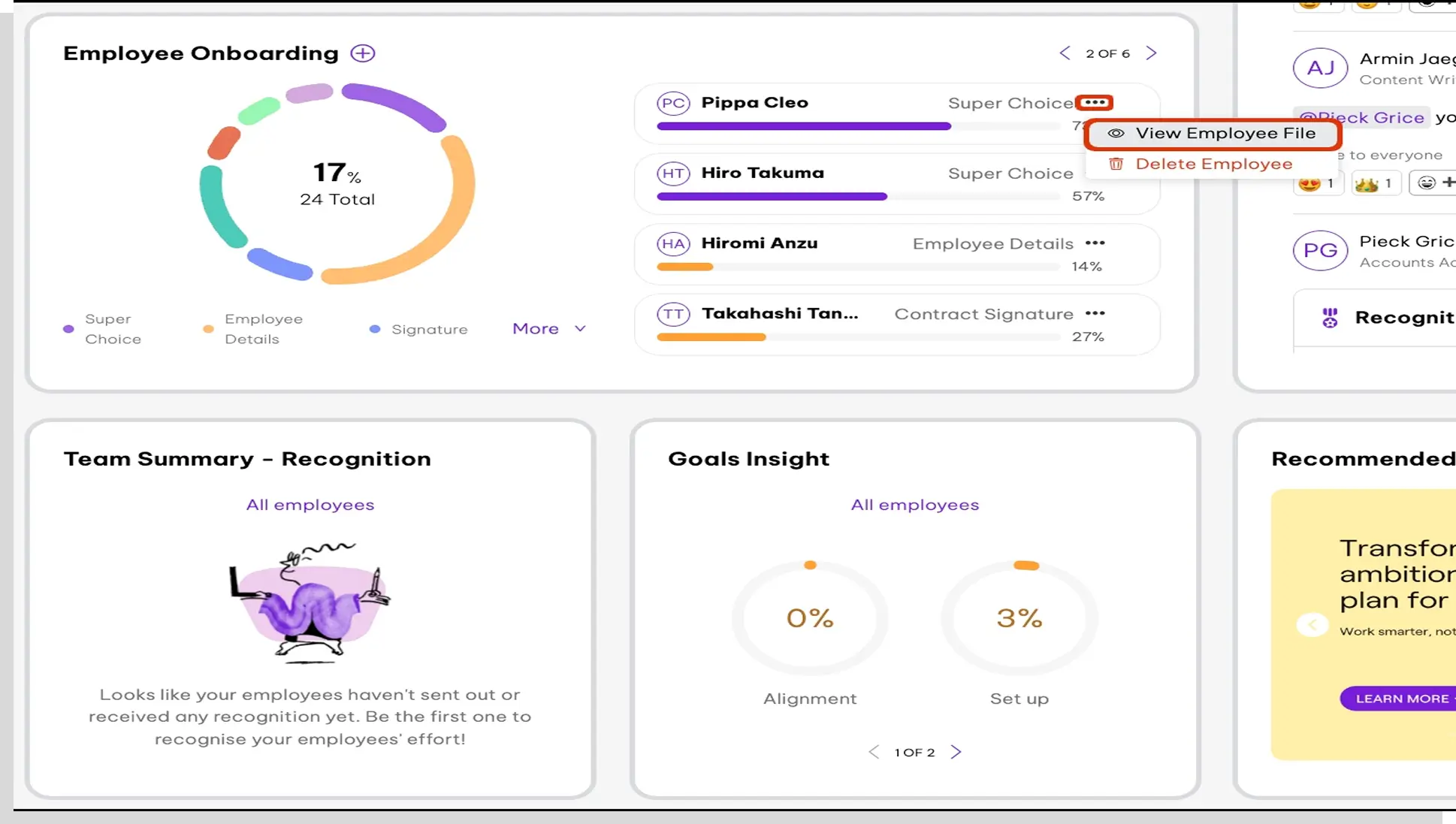
Employment Hero is an HR and payroll platform built around a wide employee engagement ecosystem. Alongside core administration it includes recruitment, onboarding, performance management, pulse surveys, and recognition, which is the broadest horizontal coverage in this comparison.
Given how much healthcare turnover costs, engagement tooling in the same place as admin is a reasonable priority.
Employment Hero Key Features
Pulse Surveys and Recognition
Built-in engagement surveys, recognition, and announcement feeds let a practice manager check how a shift-heavy team is coping without commissioning a separate survey tool. Results sit next to the employee record rather than in a standalone dashboard.
Employee Self-Service Across the Lifecycle
Onboarding, document acknowledgement, leave, timesheets, claims, and reporting run through a self-service portal with a well-regarded interface, rated 4.0 out of 5 on usability. It reduces the administrative chase that usually falls on one person.
Employment Hero Pricing
| Plan | Details |
|---|---|
| HR plans | From around USD $10 per employee per month, with a minimum monthly spend |
| Rostering and attendance | Charged as a separate add-on module |
| Malaysia guidance | Roughly RM8 to RM12 per employee per month, with a monthly minimum |
Where Employment Hero Shines
- Widest feature breadth in this list: recruitment, onboarding, performance, payroll, engagement, and recognition under one subscription
- Strong employee experience: self-service and engagement features are the product's clearest strength, and adoption tends to be good
- Useful for retention work: having survey data, performance records, and turnover reporting in one place makes it easier to connect a resignation pattern to a cause
Where Employment Hero Falls Short
- Payroll and HR are not one product: payroll was acquired separately and still requires a separate login, which creates friction exactly where healthcare employers need reliability
- Weaker MY and SG localisation: support consistency and statutory depth lag regional specialists, and the product is strongest in Australia and the UK
- Rostering costs extra: time, attendance, and rostering are a paid add-on rather than part of the core plan, which changes the real price for shift-based teams
- Longer implementation and no PSG eligibility: rollouts commonly run around six months, and Singapore SMEs cannot offset cost with grant funding
Employment Hero Customer Reviews
Employment Hero holds 4.4 out of 5 on Capterra from 239 reviews.
Who Employment Hero Is Best For
Healthcare employers who treat retention as the primary problem and want engagement tooling bundled with administration, particularly those with Australian or UK operations. If engagement is your main driver, compare it against the alternatives in our employee engagement software roundup and 360 feedback tools guide.
altHR: Best for Malaysian Clinic and Dental Groups
altHR is a Malaysian HR platform that pairs core leave, claims, and payroll with a performance suite that is genuinely built out rather than decorative: OKRs, KPI tracking, 360 feedback, peer review, self-assessment, calibration, and performance dashboards. Onboarding is also well covered, including pre-boarding, checklists, task assignment, and document collection.
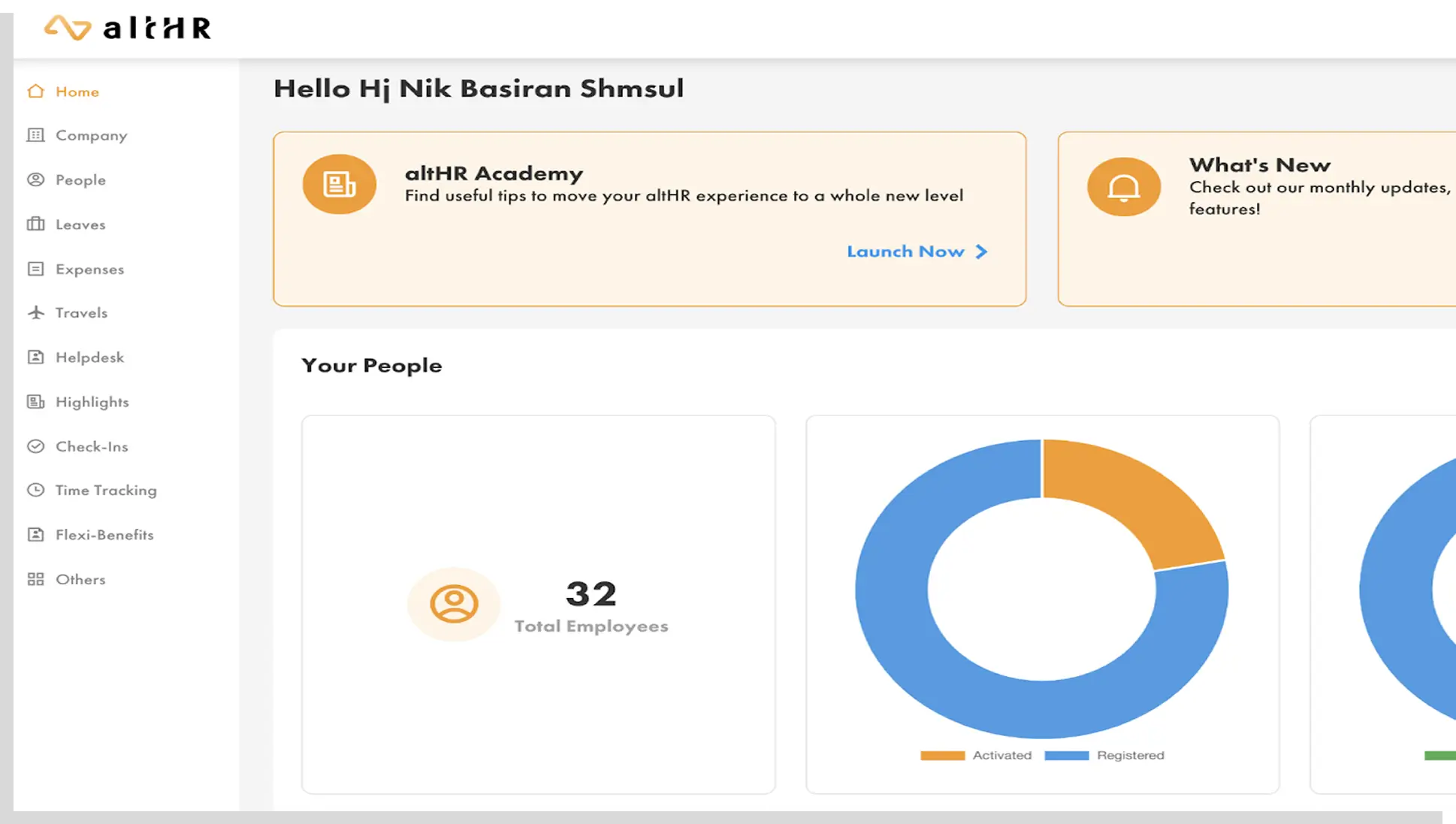
Key features: full EPF, SOCSO, EIS, PCB, and HRD Corp support with religious leave types and Malaysian public holiday sync · digital onboarding flows · OKRs and 360 feedback · asset management, which is handy for tracking issued devices and clinical equipment.
Pricing: from RM8 per employee per month for modules outside the base bundle, with some modules chargeable from RM1 per module per employee. Prices exclude SST, and payroll is delivered through a PayrollPanda integration.
Where altHR shines: the performance module is unusually deep for this price tier; onboarding workflows are cleaner than most local tools; Malaysian compliance including religious leave is handled properly.
Where altHR falls short: no Singapore payroll at all, so cross-border groups need a second system · no applicant tracking, recruitment, or managed payroll · no facial recognition or biometric device support, and geofencing is only partial, which limits it for multi-site rostering · no pulse surveys or eNPS.
altHR Customer Reviews

Who altHR is best for: Malaysia-only clinic, dental, and allied health groups that want leave, payroll, and active performance management in one local tool and do not need Singapore coverage.
HReasily: Best for Small Practices Operating Across Malaysia and Singapore
HReasily is a cloud HR and payroll platform serving SMEs in both Malaysia and Singapore, with a mobile-first interface and a low per-employee entry point. For a two-country dental or GP practice with fewer than 50 staff, the dual statutory coverage is the reason to shortlist it.
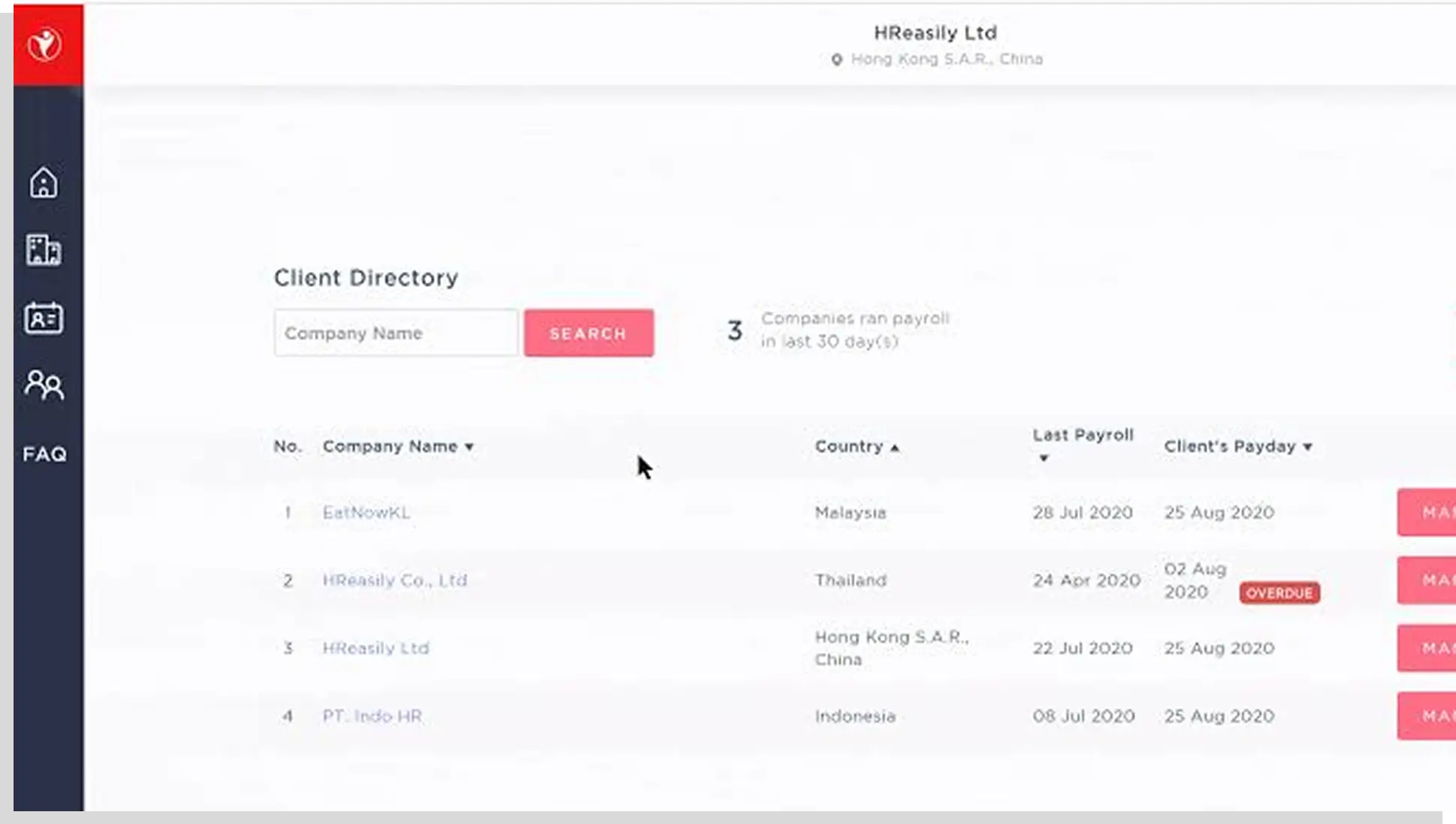
Key features: automated payroll covering EPF, SOCSO, EIS, PCB, HRD Corp, CPF, SDL, IR8A, and IR21 · mobile leave applications and GPS attendance with geofencing · shift scheduling and overtime tracking · expense claims with receipt upload and reimbursement through payroll · compliance reporting.
Pricing: from RM4 per employee per month in Malaysia, with Singapore entry pricing quoted from around S$2 per employee per month depending on modules.
Where HReasily shines: genuine dual-country statutory payroll at the low end of the market; mobile accessibility for staff who never sit at a computer; statutory updates applied automatically so a practice manager is not tracking rate changes.
Where HReasily falls short: no recruitment or applicant tracking, no performance management, and no learning and development, so it covers administration only · onboarding is not a structured workflow · reporting is basic, with no custom report builder or people analytics, which becomes a constraint past roughly 100 staff · no document e-signature, no facial recognition, and no biometric hardware integration · implementation typically takes around three months, longer than the product's simplicity suggests.
HReasily Customer Reviews
Who HReasily is best for: small medical, dental, and specialist practices with staff in both Malaysia and Singapore that need payroll and attendance handled affordably and will manage hiring and performance outside the system.
Healthcare HR Feature Comparison at a Glance
| Capability | brioHR | QuickHR | Swingvy | Workday | Employment Hero | altHR | HReasily |
|---|---|---|---|---|---|---|---|
| Rotating shift support | Yes | Yes | Partial | Yes | Add-on | No | Partial |
| Geofenced mobile clock-in | Yes | Yes | Yes | Via integration | Add-on | Partial | Yes |
| Facial recognition | Yes | No | No | Via integration | No | No | No |
| Biometric / RFID device integration | Yes | Partial | No | Via integration | No | No | No |
| Native Malaysian payroll | Yes | Via partner | Yes | Configured | Partial | Yes | Yes |
| Native Singapore payroll | Yes | Yes | Yes | Configured | Partial | No | Yes |
| Document management + e-signature | Yes | Yes | Partial | Yes | Yes | Partial | No |
| Performance review cycles | Yes | No | Basic | Yes | Yes | Yes | No |
| Pulse surveys / eNPS | Yes | No | No | Yes | Yes | No | No |
What Features Should Healthcare Organizations Look for in an HR Platform?
Healthcare has requirements most HR buying guides skip. These are the four that decide whether a platform survives its first year in a clinical setting.
Rotating-Shift Rostering That Survives Real Coverage Changes
Ward rosters are not weekly repeats. Nights alternate, staff swap at short notice, part-timers cover across two sites, and overtime rules differ by contract type.
Ask any vendor to demonstrate a rotating pattern with a mid-week swap, then show the resulting timesheet and the overtime calculation. Many tools handle scheduling and attendance separately, which means somebody reconciles them by hand every month.
"HR software is the only software used by everyone in the company... some people might say now it's email. No, in F&B most people don't have a company email or in construction, however, they clock in and out every day, they get their pay slips."
The same holds in healthcare. A healthcare assistant may never open a work email, but she clocks in every shift and needs her payslip.
brioHR handles rotating patterns, geofenced mobile clock-in, facial recognition, and biometric hardware in one attendance module, and approved hours move into payroll without an export.
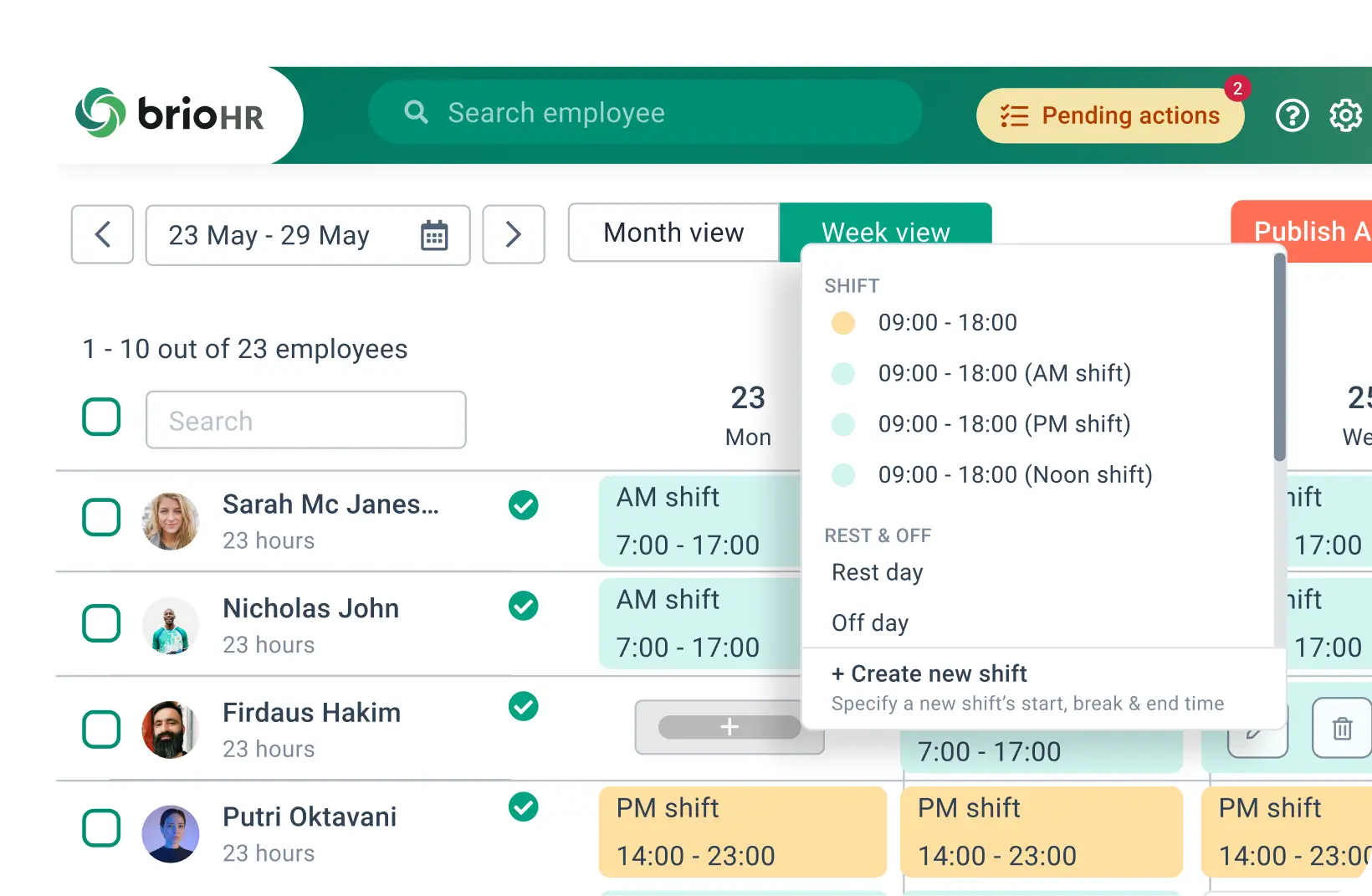
Bring us your messiest roster. Request a demo and we will build it live, including the swap that always breaks your current spreadsheet.
Payroll That Handles Multiple Cycles and Statutory Detail
A hospital or clinic group often runs monthly salaried payroll, a separate hourly or weekly cycle, locum payments, and shift differentials in the same month.
Check that the platform supports multiple pay frequencies natively, calculates every statutory item for your country, generates the year-end forms, and updates rates automatically when the law changes. Singapore employers should confirm CPF handling specifically, and our summary of CPF contribution updates shows how often these shift.
Two useful reads before you decide: how payroll software reduces cost and which platforms handle automated payroll well. brioHR supports multi-cycle payroll with attendance, leave, and claims feeding each run.
Leave and Absence Rules That Match Clinical Reality
Healthcare leave is complicated: hospitalisation leave, unplanned sick leave that immediately creates a coverage gap, replacement leave for public holiday shifts, and carry-forward rules that differ by grade.
The platform should support custom leave types, accrual rules, multi-level approval, carry-forward and expiry, and replacement leave, then reflect the balance on the roster so a manager sees the gap before the shift starts. Singapore employers can cross-check requirements against our guide to the 14 types of leave every HR in Singapore should know, and absenteeism covers the patterns worth monitoring.
brioHR's leave and time-off module covers all of the above and shares a calendar with attendance, so approved absence and roster coverage stay in sync.
Document Retention, Security, and Audit Trails
Practising certificates expire. Vaccination records get requested. Disciplinary files need to be produced years later, complete and unaltered.
Look for role-based permissions granular enough that a unit manager sees her team's records but not the whole organisation's, document storage tied to the employee file, e-signature for contracts and variations, and a full audit log of access and changes. ISO 27001 certification is a reasonable baseline given the sensitivity of the data involved, and brioHR's security controls set out what that covers in practice.
How We Selected the Best Healthcare HR Software
Our criteria deliberately differ from the feature checklist above. These are the tests we applied to each platform as a product and a vendor.
Local Statutory Accuracy, Verified Not Claimed
We checked whether payroll engines are native to Malaysia and Singapore or delivered through a partner or configuration layer, and whether statutory forms and e-filing are generated in-platform. Partner-delivered payroll is not disqualifying, but it changes who you call when a contribution rate is wrong three days before cut-off. We also looked at whether statutory updates roll out automatically.
Usability for Non-Desk Clinical Staff
A healthcare HR platform fails quietly when a night-shift assistant stops clocking in properly because the app is confusing. We weighted mobile experience, self-service clarity, and independent usability scores heavily, and we discounted feature counts that assume an office worker with a laptop.
"no tech is better than bad tech... a new joiner coming to the company, do they need a training to use the HR software? If yes problem, it should be easy, it should be beautiful."
Support Responsiveness and Implementation Time
We compared documented response times, local business-hours coverage, and typical implementation length, which ranges from about one month to 24 months across this list. For an employer that cannot delay payroll or leave a ward uncovered, a vendor answering on a different continent's clock is a genuine operational risk. We also checked whether managed payroll and outsourced support are available as a fallback.
Pricing Transparency and Total Cost
We favoured platforms that publish a starting price and are clear about which modules cost extra. Add-on rostering, separate payroll licences, and implementation fees change total cost significantly, and several vendors here bury that detail. We also noted grant eligibility, since PSG funding materially changes what a Singapore practice pays. Our article on why companies invest in HR software sets out how to build that business case internally.
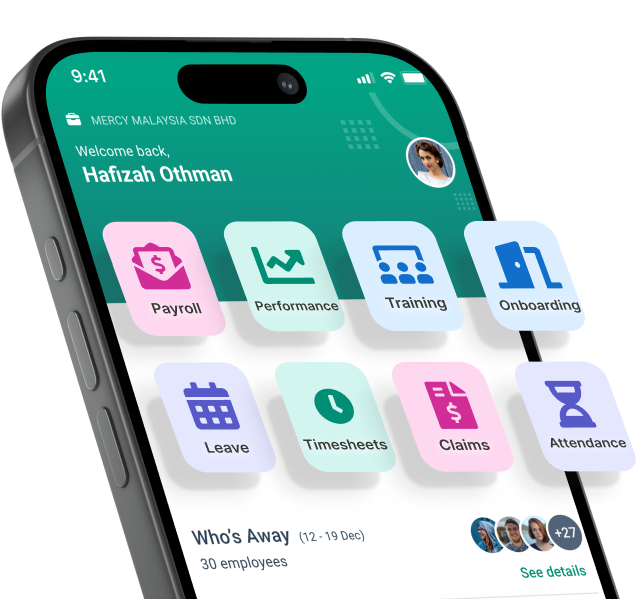
Everything HR.
One login
From payroll to onboarding, brioHR gives you everything you need in one place. Built for busy teams. Backed by people who care.
Simplify Healthcare HR Management With brioHR
Different healthcare organisations should land in different places here, and the honest recommendation depends on your shape.
If you run a hospital network above 10,000 staff with an HRIS team and a multi-year budget, Workday is the right tool and nothing smaller will hold. If you are a Singapore-only practice that needs audit-ready records and will manage hiring separately, QuickHR with PSG funding is a strong, cost-effective answer. Home-care and community teams where everything happens on a phone should look hard at Swingvy. Malaysia-only groups wanting performance management alongside admin will get real value from altHR, and very small two-country practices can run capably on HReasily.
brioHR is the fit when you need rotating-shift attendance, statutory payroll for Malaysia and Singapore, credential records, and workforce reporting to behave as one system, and when support answering in minutes during payroll week matters more than a longer feature list.
Talk to someone who has done this for a clinic group. Request a demo or ask about managed payroll if you would rather hand the monthly run to a specialist team.
Conclusion
- brioHR is the fit when you need rotating-shift attendance, statutory payroll for Malaysia and Singapore, credential records, and workforce reporting to behave as one system.
- Workday is the right tool for a hospital network above 10,000 staff with an HRIS team and a multi-year budget.
- QuickHR with PSG funding is a strong, cost-effective answer for a Singapore-only practice that needs audit-ready records and will manage hiring separately.
- Home-care and community teams should look hard at Swingvy, Malaysia-only groups wanting performance management will get real value from altHR, and very small two-country practices can run capably on HReasily.