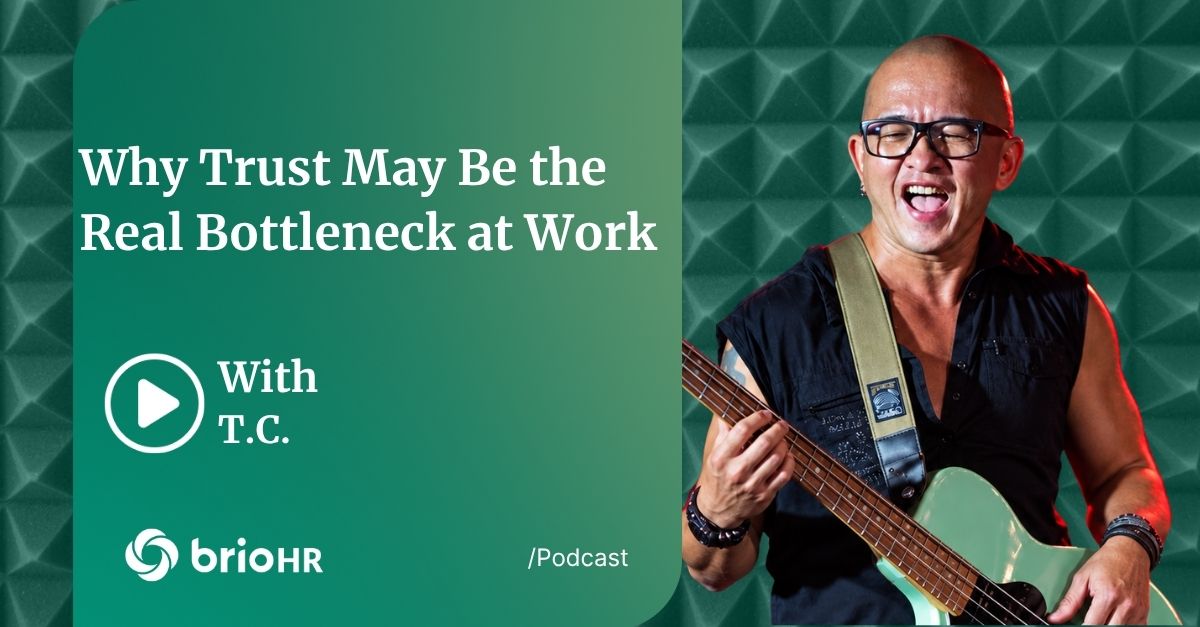
Why Trust May Be the Real Bottleneck at Work – T.C.
Key Takeaways
- Poor working relationships often show up as slow replies, withheld help and tasks that take longer than they should.
- Singing together makes people listen to one another. If one person ignores the other, everyone can hear it.
- Team building should affect how people work after the event, not only how much they enjoyed the day.
In this episode of the with brioHR podcast, Mattie speaks with T.C., founder of Gig For Good, about why he puts colleagues and leaders on stage together, and what happens when they have to perform in front of their own teams.
T.C. is describing an exercise he uses with two colleagues who struggle to work together. One sings the main part of a Britney Spears song. The other takes the harmony. Neither can finish the song without listening to the other.
This is one of the ways Gig For Good uses live music with teams. Colleagues rehearse and perform together, often in front of the people they work with every day.

Before starting Gig For Good in 2023, T.C. spent almost thirty years in advertising. He began as a copywriter in 1992 and founded his own agency in 2003. He was also a self taught musician who had been performing since his teens. Gig For Good brought those two parts of his life together.
The Fear Starts Before Anyone Sings
When a microphone is passed around a room, people react quickly. Some laugh. Some look away. Others refuse before they know what they are being asked to sing.
T.C. sees the same reaction at work. Someone has a question but decides not to ask it. An employee has an idea but waits for a more senior person to speak first. A manager avoids admitting they are unsure because they think the team expects an answer.
During a Gig For Good session, the group rehearses before performing. People hear each other miss notes and forget words. Once everyone has made a mistake, the room pays less attention to who is good and more attention to getting through the song.
For some participants, that is the first time they have performed in front of a crowd since school. Finishing the song gives them a new reference point the next time they have to speak in public.
The Problem Behind the Delay
One of T.C.'s points has nothing to do with music. A colleague sends an urgent request near the end of the day. The recipient could stay for another hour and finish it, or leave it until tomorrow. The decision may depend on who asked.
The delay may later be described as a process issue or a lack of cooperation. The reason itself may never be discussed. People make these small choices every day. They reply faster to colleagues they trust. They share more information with people who have helped them before. They are more willing to step outside their job description when they believe the effort will be returned.
That is why T.C. pays attention to relationships when companies talk about performance. A new process will not fix two people who have stopped trying for each other.
Fear and confidence are basically two sides of the same coin.
Why the Song Helps
At work, two people can keep a disagreement going through email, meetings and reporting lines. In a band, the problem becomes obvious much faster. The verse arrives at a fixed time. The harmony has to meet it. If one person rushes, the other has to adjust. If somebody loses their place, the group has to recover without stopping.
There is also an audience. People take the rehearsal seriously because they know others will see the result. One song will not settle every disagreement. It does give the two people a recent example of completing something together. The next time they meet at work, they are no longer dealing only with the history of what went wrong between them.
Leaders Have to Join
Employees notice whether management participates or watches from the side. When a CEO takes the microphone, they accept the same chance of missing a note or forgetting a line as everyone else. The team does not need the CEO to sing well. They notice that the CEO agreed to take part.
This is different from how employees usually see senior leaders. Presentations are prepared. Speeches are rehearsed. The leader is expected to look certain. On stage, there is less control. The person asking others to try something unfamiliar has to do it too. For T.C., that decision tells employees more than another speech about openness or trust.
Make performance management effortless
Streamline goals, reviews, and feedback in one flow—so managers can focus on real performance conversations.

Start With the Feeling
T.C. brought one question from advertising into the way he designs each session. What should people feel when it ends? An HR team will usually begin with the activity, the schedule and the learning objectives. T.C. begins with the response he wants from the room.
Should people feel more comfortable speaking in front of each other? Should two departments be less guarded? Should new managers feel able to lead without pretending to know everything? The answer affects who performs together, how the session is introduced and what happens after the song. It also gives HR a clearer way to choose an activity. A team that rarely speaks across departments needs a different session from a group learning to present to clients.
Playing and Performing
T.C. also separates playing a song from performing it. A musician can hit every note correctly and still leave the audience cold. A performer understands what the song is saying and makes the audience believe it.
He sees the same difference in the workplace. Someone can read every slide without holding the room. A manager can repeat the company values without showing them in practice. A CEO can deliver the approved message while sounding disconnected from it. People notice when someone is only going through the material. They also notice when the person speaking means it.
What Should Still Be Different on Monday?
Teams can have an enjoyable afternoon and return to the same habits the next morning. T.C. asks companies to decide what they expect to change after the activity. If the purpose is simply to let employees have fun, that is a valid reason. If the company expects better teamwork, it needs to be more specific.
Perhaps two managers need to speak without involving a third person. Perhaps employees need to ask questions earlier. Perhaps senior leaders need to become easier to approach. The activity should give people a chance to practise that behaviour while they are together. Otherwise, the company has organised entertainment and called it development.
Conclusion
- Gig For Good uses music because a performance makes people pay attention to each other. They have to listen, enter at the right time and continue when somebody makes a mistake. The office problems do not disappear when the song ends. The people involved have seen each other behave differently, and that can change the next conversation.
Everything HR.
One login
Cut the extra layers in your HR process. Keep what works, remove what doesn’t, and make everyday work easier for your team.
Watch the full episode of the with brioHR podcast to hear how Gig For Good began and what T.C. has learnt from putting employees and leaders on stage together.
To learn more about how brioHR can transform your HR processes, check out brioHR’s website or request a demo.